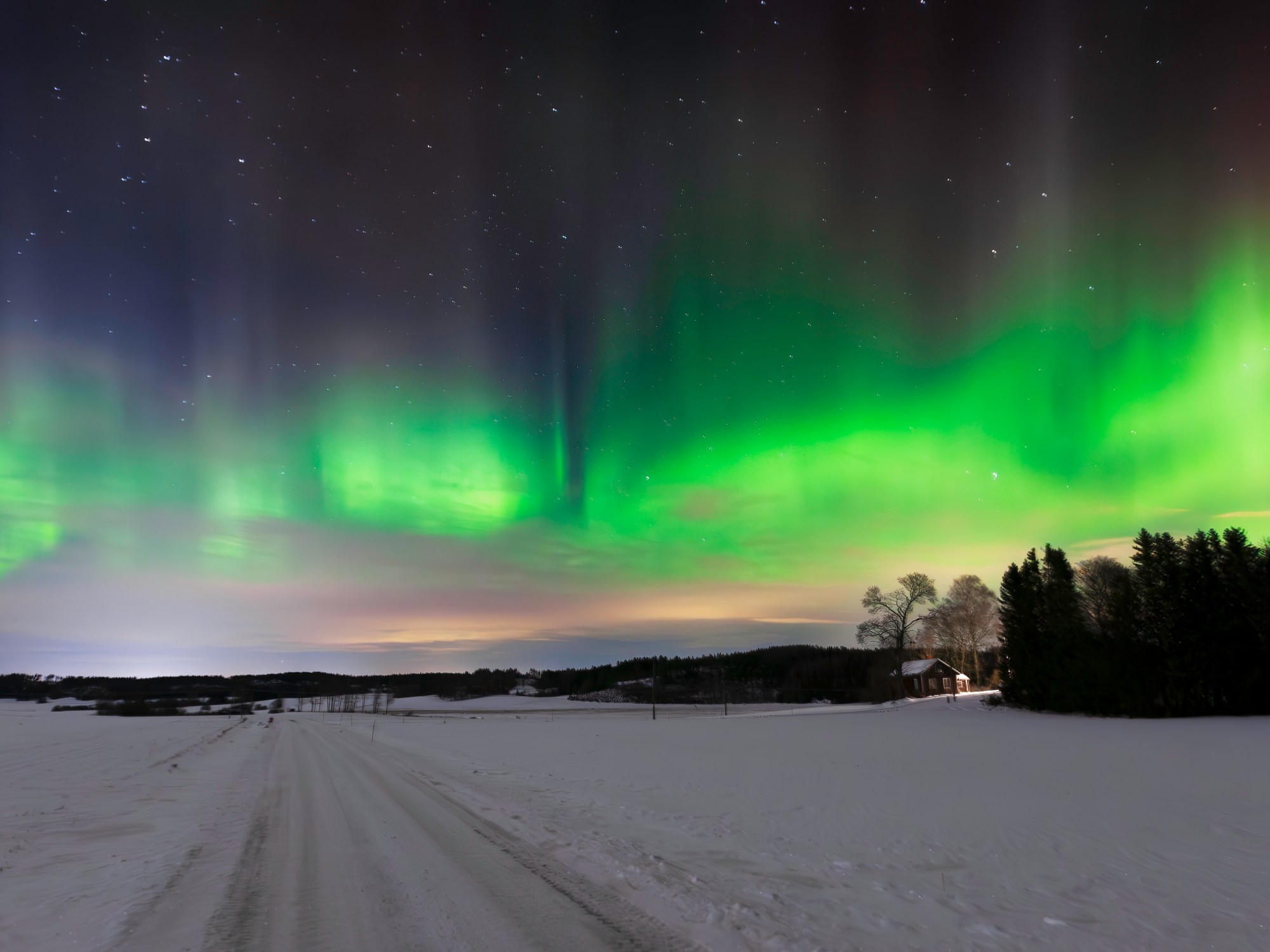
Aurora Borealis, those enchanting northern lights, arrive unannounced and uninvited to dance across the night sky. Their sudden appearance ignites a chorus of excitement on social media, and I can’t help but wonder if I’ll get to witness this celestial spectacle next time.
The challenge in capturing the beauty of the auroras lies in the fact that they only reveal themselves in the darkness of the night. To catch a glimpse of these ethereal lights, sometimes you must stay awake through the entire night. For those with a full-time job, night photography can be demanding, and it’s rare to have the energy to chase the Northern Lights in the middle of the week.
Before the arrival of spring this year, I had only witnessed the Northern Lights a few times, and they appeared rather faint – more like faint greenish clouds drifting across the sky. What captivates me about the Northern Lights is their stunning colors and the intricate patterns they form. Capturing the mesmerizing dance of the vibrant lights has been and still is high on my bucket list.
In February 2023, the Aurora Forecast Was Favourable
The spring of 2023 turned out to be an active time for the Northern Lights. I was busy due to my work and had no time for photographing anything. However, one evening in February, the news mentioned that the chances of witnessing the Northern Lights were favourable, despite the cloudy skies. I quickly checked the weather forecast, which indicated that the skies would clear up as the night progressed. Without a second thought, I decided to drive to my cabin to capture this breathtaking phenomenon.
Pale Green Clouds Transform into Faint Northern Lights
My cabin is situated far away from the city, away from the intrusive glow of artificial lights. During the winter, it gets incredibly dark there and to witness the Northern Lights, the best place is to stand on the frozen lake and look at the northern sky.
I wasn’t particularly keen on venturing onto the lake, as the previous weekend had seen ominous creaks and groans from the ice. Furthermore, there had been warnings about unstable ice conditions in the news. Yet, there was no choice but to tread cautiously onto the ice and stick close to the shoreline, where the water is shallow.

The sky above displayed pale, ethereal clouds that waxed and waned in intensity. While my camera captured the faint Northern Lights distinctly, I patiently awaited their intensification.

At times, it seemed promising, and I stood on the ice for about an hour and a half, capturing relatively faint auroras.

I kept an eye on the aurora forecast throughout, which indicated that the chances of seeing the lights in the south were diminishing. Regretfully, I made the decision to gather my gear and head back home. It was disappointing not to have witnessed the magnificent light show I had eagerly anticipated. However, I had to return because the following day was a workday, and a good night’s sleep was imperative.
On the Way Home, I Witness the Dance of the Northern Lights
I was halfway on my journey back home when suddenly, I spotted the Northern Lights dancing in the sky, vibrant and green. I managed to capture the mesmerising display for about 10 minutes before the show concluded.

I assume the pattern is curtains.


I had been privileged to witness this breathtaking performance and had even obtained my first-ever photos of the green Northern Lights. Exhausted but elated, I couldn’t help but smile. One of my goals had been fulfilled!
A Colorful Nighttime Phenomenon – The Aurora Borealis
Aurora Borealis, commonly known as the Northern Lights in the northern hemisphere and Aurora Australis in the southern hemisphere, are nature’s dazzling light shows that grace the night sky, predominantly near Earth’s polar regions. They’re especially prominent and breathtaking in areas close to the poles, such as the Nordic countries, northern Canada, Alaska, as well as Antarctica and its vicinity.
Birth of auroras
The birth of these enchanting lights is intertwined with the interaction between solar wind and our planet’s atmosphere. Solar wind comprises charged particles from the solar system, which collide with Earth’s magnetic field. This interaction illuminates gases in our atmosphere, particularly oxygen and nitrogen, causing them to emit a vibrant spectrum of colors, such as green, red, blue, and violet.
Colors and patterns of auroras
The specific colors and patterns depend on the type and altitude of the gases. Aurora displays can take on a multitude of shapes and move across the night sky in undulating bands or arcs, creating a mesmerising spectacle for all who are fortunate enough to witness them.
Colors
Green is the most common color of the auroras and is caused by the interaction of charged particles from the sun with oxygen at lower altitudes in the Earth’s atmosphere. This green light can vary in shades, from pale lime green to deep emerald.
Red auroras are less common but can be breathtaking. They result from high-altitude oxygen interactions and are often seen during more intense geomagnetic storms. The red hue can range from a soft pinkish-red to a rich crimson.
Blue and purple hues are less frequent and are caused by nitrogen molecules in the upper atmosphere. They tend to appear at higher altitudes and are typically seen in combination with other colors.
Patterns
Auroras come in various patterns: curtains, arcs, corona, rays, beams, pulsating auroras, and crown-like circles.
Curtains are classic, vertical, wavy bands of light resembling hanging drapery. Arcs form sweeping, semi-circular shapes spanning the horizon, creating a captivating arch. Corona is a circular pattern of light overhead, giving a stunning, almost 3D effect. Rays shoot up from the horizon like celestial pillars, while pulsating auroras display fluctuating intensity. Finally, crown-like circles create concentric rings of light radiating from a single point, captivating the sky.
The specific colors and patterns you witness depend on the altitude of the auroras, the type of gas particles involved, and the energy of the solar wind at the time. Aurora displays are dynamic and ever-changing, making them a captivating and unpredictable natural phenomenon to behold.
Best places to Witness Northern Lights in Finland
The Northern Lights are a popular attraction, especially in the northern latitudes, and many travelers journey to these northern regions to marvel at them. They are most vividly seen in the darkness of the night and under a clear sky, far away from the lights of the cities. The aurora season typically runs from September to April. However, the peak months are in the heart of winter, from December to February.
Finnish Lapland is renowned for its clear, dark skies, making it one of the prime locations to experience the Northern Lights. Rovaniemi, Saariselkä, and Ivalo are popular destinations in Finnish Lapland. The Kakslauttanen Arctic Resort offers unique glass igloos, providing a cozy viewing experience right from your bed.
I hope you’ve enjoyed my Northern Lights story. Stay tuned for more tales from the Finnish wilderness, coming soon!
Minna from Finnish Nature photos
 MINNA JACOBSON
I would be very excited to see those lights. relatives of mine lived in Maine and they saw them but only once did I catch the faintest glimmer when I was there. I’m not surprised you jumped in your car and rushed off. I would have too. Standing around on unreliable ice in the pitch dark and cold shows determination. How nice that you got a good show driving back and thank you for writing about it and posting your photographs. And the video.
LikeLiked by 1 person
Thank you and you are welcome! It was amazing show that I still remember the feeling and exitment. I hope to see auroras this winter and get great shots.
LikeLike
Great shots and congratulations!
LikeLiked by 1 person
Thank you very much 😊
LikeLiked by 1 person
Having lived in Canada’s north for six years (I moved back to the south in May), I have seen them often. Your photos here are beautiful captures of this amazing display. Congratulations!
LikeLiked by 1 person
Thank you Lynette! Auroras are so amazing! You have been lucky to live in North Canada where auroras can be seen often. Hopefully I will see them this winter again.
LikeLiked by 1 person
Great shots. I have seen the real aurora only once.
LikeLiked by 1 person
Thank you so much. In South part of Finland, where I live, auroras are not so common. I am planning a trip to Lapland this winter to chase the Northern Lights 😊
LikeLiked by 2 people
True. I live in Somero and auroras are often just white…
LikeLiked by 1 person
Great photos and the video is spectacular, possibly the best representation I’ve ever seen online. Having never seen them myself, I enjoy the auroras vicariously through the endeavors of others. Thank you so much!
LikeLiked by 1 person
Thank you Kate! If you are interested in seeing the auroras, follow Avaruussää by Ilmatieteenlaitos. Because in Lohja you have possibility to see them 😊 Happy chasing!
LikeLiked by 1 person
WOW … these are fabulous images and great information too! I would like a chance to photograph the Northern Lights. I got a little taste of it in Iceland but it was not the right time of year for great results like these.
LikeLiked by 1 person
Thank you Denise! Last year was active time for auroras, so it was also possible to see them in South Finland. But in the North you see them more often. I keep my thumbs up that you see them one day!
LikeLike
Wonderful shots Minna – something I have not had the privilege of experiencing yet.
LikeLiked by 1 person
Thank you so much! Hopefully some day you have a chance to visit f.e. Lapland and see auroras. It is an event that you will remember for ever.
LikeLike
Boy, isn’t the Aurora just so enchanting? Lovely pics and those where she really was dancing are just fantastic. The viewing of the northern lights was awesome in the early part of the year for sure — and our cloud-cover even cooperated here in Oslo and we got a show as well. Now that the season is starting up again, it’s time to be ready for those clear nights and hope it isn’t too cold out. Fingers crossed. Lovely post!
LikeLiked by 1 person
Thank you so much! Auroras are mysterious and enchanting. We, living in the Northern part of the world, are lucky, as we have a change to see those dancing lights in the nightsky. Hopefully they will be seen many times during this winter!
LikeLiked by 1 person
Your photos are absolutely magickal! How amazing to be able to photograph these incredible lights!
LikeLiked by 1 person
Thank you so much! It was amazing moment when the Northern lights were dancing on the sky. I hope to see them as vivid during this winter.
LikeLiked by 1 person