
In the serene countryside, my snug cabin becomes a winter haven for our feathered friends. As the cold season arrives, it’s become a daily ritual to care for our local birds, and their visits bring warmth to each day.
Mornings, with a cup of coffee in hand, are when I savor watching these birds and their daily routines. Especially I look for the Eurasian Jay to visit us, as I find it very interesting bird and it is nice to observe its activities in the backyard.
Eurasian Jay – intelligent bird
Occasionally, we’re graced by a special visitor – the Eurasian Jay. You can sense their arrival even before you see them, thanks to their piercing, screechy calls that break the quiet countryside. It’s always a delight when they appear, for they are truly captivating creatures.

Eurasian Jays boast striking, multicolored plumage painted in shades of blue, black, white, and pink. Their vibrant feathers create a visual treat for the eyes.

Besides the colorful appearance, these birds also shine with their intelligence. They’ve been caught solving problems and even using tools, like sticks, to extract food. Their smart ways have attracted the attention of scientists.

And here’s a tidbit: they’re quite the mimics, imitating the calls of other birds. I heard from radio that they have mimicked even Pygmy Owls.
Eurasian Jays are adaptable birds that inhabit woodlands and are equally comfortable in urban and suburban areas. Their omnivorous diet, which includes a wide range of plant and animal food sources, demonstrates their versatility and their role as important seed dispersers in forest ecosystems.
Acorns are a primary food source for Eurasian Jays, especially in the autumn. They have specialised throat pouches to carry and store acorns, which they bury for later consumption. Their caching behavior and ability to store and locate food make them interesting and ecologically significant birds.
The Rivalry in the Skies: Eurasian Jay and Sparrow hawk Battle
As some of my readers may know from previous posts, I’ve ventured to Kuusamo in pursuit of photographing the magnificent Golden Eagle. Yet, during eagle-watching, I’ve had the joy of capturing the beauty of other feathered visitors in the area, including the Eurasian Jay.

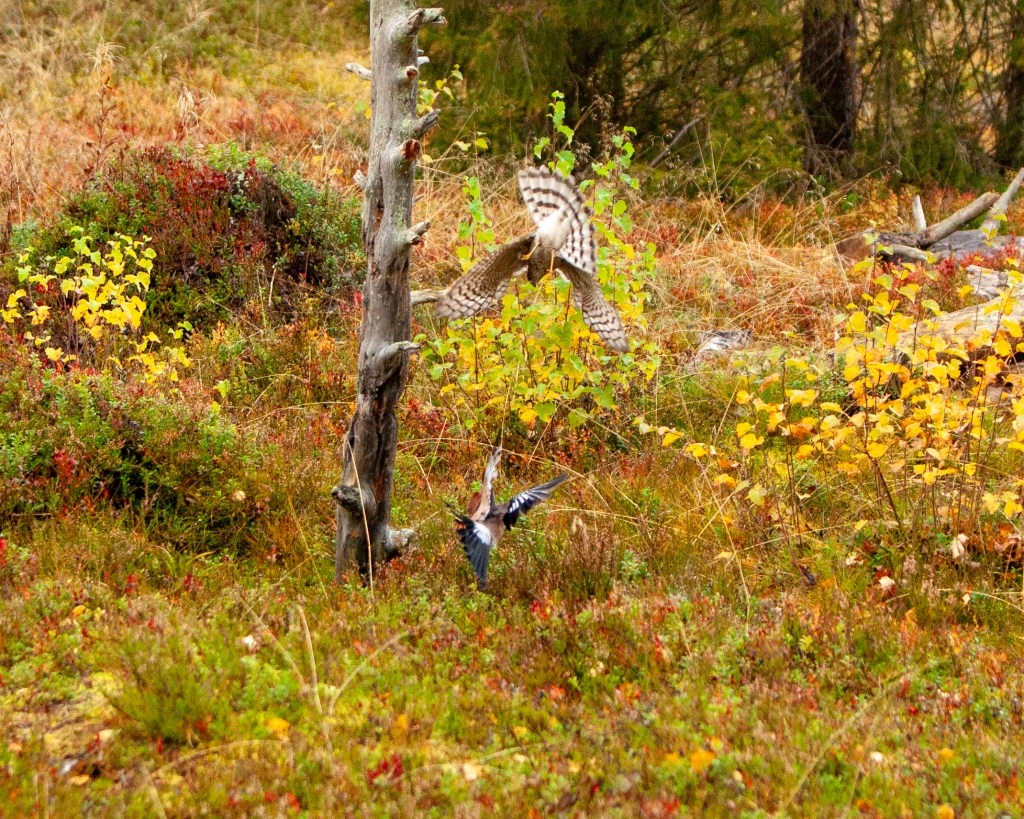
Around a year ago, I had the privilege of witnessing an enthralling event: a Sparrow hawk in pursuit of an Eurasian Jay.

Sparrow hawk was chasing Eurasian Jay for hours and I realised that the longer the hawk chased the jay, the more irritated it looked.
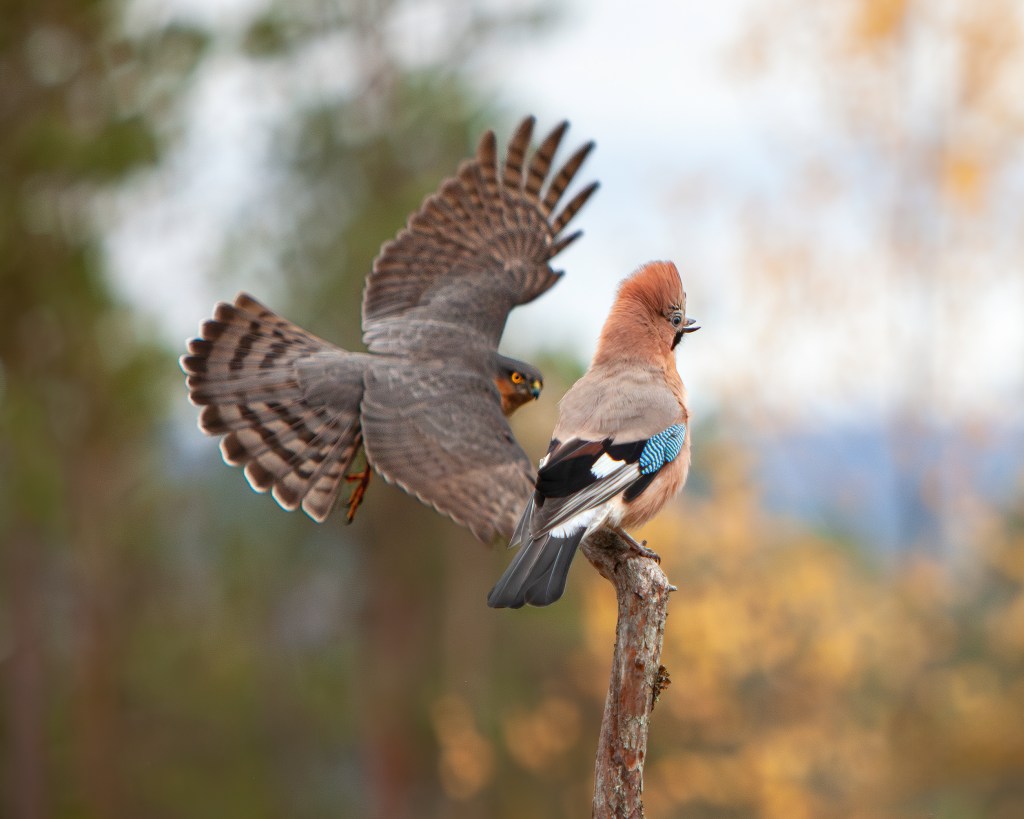
What adds to the intrigue is the Eurasian Jays unique posture, with its head feathers resembling an elaborate headdress.

The reasons behind this chase could be many: perhaps it was about a meal, guarding territory, competition for food, or simply following instincts.

These interactions remind us of the complex web of connections and behaviors that mold the natural world, and each situation brings its own flavor to the mix.
By peering through my camera lens and tracking the movements of the Eurasian Jay in our backyard, I’ve gained valuable insights into this captivating bird. I’m truly fascinated by its behaviour, and I feel fortunate that the jay is a frequent visitor to our bird feeding area.
I’d love to hear about your experiences with Eurasian Jays. Your comments and stories are highly valuable to me, so please feel free to share!
Minna from Finnish Nature
 MINNA JACOBSON
Those photographs are stunning! I had not seen an image of the Eurasian Jay before. It is beautiful and has similarity to our Blue-jays. I think the behaviour is probably similar too. We have a lot of hawks here and they are mostly harassed by crows. I think sometimes the Red-tailed hawks prey on Blue-jays, though mostly they take the little Mourning doves. It always makes me sad because the doves are sweet, but everyone has to eat and the doves are numerous. I never tire of watching birds. In Washington State we had Stellar Jays which were entirely bright blue. I’ll be interested to learn more details of what you observe as time goes on.
LikeLiked by 1 person
I checked on google those birds you mentioned in your commwnt. Blue-jays are so beautiful. They have smilar pattern on the wing as Eurasian Jay, so most likely they are related to each other.
Red-tailed hawks seem to be bigger than Sparrow hawk. Because of that they may even catch Blue-jay. Sparrow hawks are quite similar size as Eurasian jay, but you never know, if they are able to catch jay, they will probably also eat it.
I am also sad when hawk cathes a bird. But as you said, they are predators and eat meat. Quite natural.
I am glad you liked my post and photos! Thank you 😊
LikeLike
The Jay is a real tough guy, although I never see them at my bird feeders (too urban). But now, during autumn, they are heard everywhere in the forest and scream immediately when you imitate their hoarse Donald Duck sound.
LikeLiked by 1 person
Really! So they are imitating 😊 I have to try that too. Thanks for telling me 🌞
LikeLike
These are spectacular photos. Here in the Southern USA we have blue jays which are shrill. The mockingbirds are the brave ones in our neighborhood who will drive the hawks away. They will also drive the crows away.
LikeLiked by 1 person
Thank you so much!
I assume jays are related to each other. I checked from
Google the Blue jay. It is really beautiful bird. I have never seen it as it lives in the southern part of the world.
Mockingbird seems to be really brave. It would nice to photograph when it is chasing a hawk 😊
Thank you for sharing your story of Blue jay and Mockingbird.
LikeLike
Google says:
Blue jays and Eurasian jays are both members of the Corvidae family (which they share with crows and ravens), but blue jays are part of a separate genus, Cyanocitta.
The mockingbird is indeed very brave.
LikeLiked by 1 person
Thanks for checking! Now we know 👍
LikeLike
Gorgeous photos of this beautiful bird!
LikeLiked by 1 person
Thank you Magickmermaid!
LikeLiked by 1 person
I saw once a Jay capture a little mouse in our snowy garden in winter. The Jay was quick and effective. Eheh…😉😄
Your shots are stunning. 👍
LikeLiked by 1 person
Eurasian Jay is eating meat as well. Nice story, thank you for sharing 😊 And thank you for your compliment 🙏
LikeLiked by 1 person
Excellent study and shots!
LikeLiked by 1 person
Thank you so much 🙏
LikeLike
Amazing sight, the interaction between the Jay and the hawk! I think I’ve seen the Jay but it’s not so common in our garden. We have the ubiquitous sparrows but beyond those, our daily visitors are the crow, magpie, blue and great tits and blackbirds. Sometimes a Robin. Otherwise, we get occasional seasonal surprises but then one must be lucky and attentive yo spot them. Another common bird around the neighborhood is the spotted woodpecker and, of great amusement to me, there is a male that has found and commandeered one of our feeders – the one with nuts in a wire mesh that normally attracts the tits. This woodpecker now visits many times a day and is so noisy about it, I don’t even have to look to know he is there. Thanks for your post and including us in your bird-sighting adventures…
LikeLiked by 1 person
Thank you for your inspiring comment! Interesting behviour with one of your woodpeckers 😊
We have the same birds also visiting the feeding place. Great spotted woodpecker also hanging in the metal feeder. It is so funny to watch them!
LikeLiked by 1 person
Quite an interesting Jay. We have several of the Jay family here in the States, but this one is quite pretty. First time I have seen this one, thanks for sharing
LikeLiked by 1 person
Thank you for your kind comment and you are Wellcome. I am glad you liked the Eurasian Jay.
LikeLiked by 1 person
What a wonderful set of shots! The dual between the Jay and the Sparrowhawk is beautifully captured. I’ve photographed similar fights between Merlins and crows or jays, and have yet to get results as nice as these. Good work!
LikeLiked by 1 person
Thank you, I am glad that you liked it!
LikeLiked by 1 person