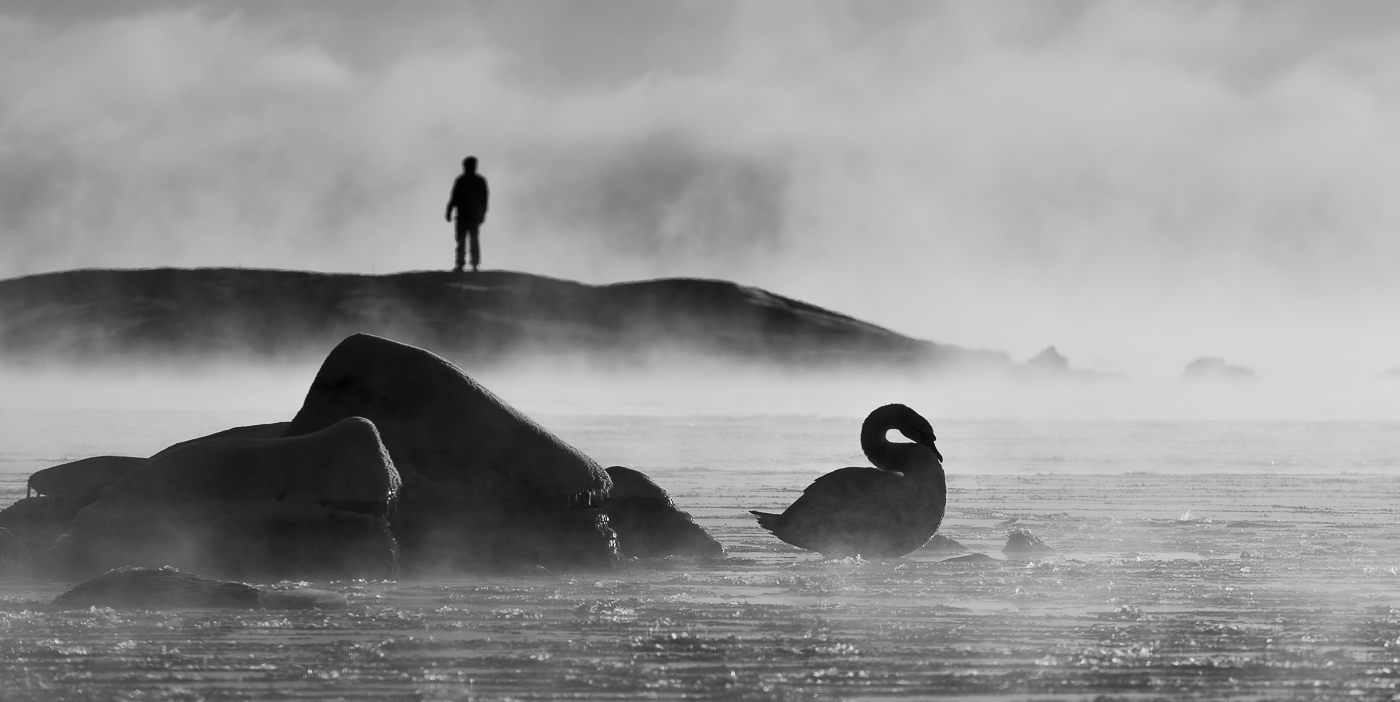
The year began in deep frost. On January 6th, temperatures in southern Finland dropped to around −20°C. I had already decided the weekend before that if the cold held, I would head to Lauttasaari with my camera.
Lauttasaari is a large island located just west of Helsinki city center. It is home to one of the city’s longest and most accessible shorelines. Surrounded by open sea, bays and narrow straits, it offers uninterrupted views across the Baltic Sea in several directions.
In winter, Lauttasaari is especially interesting for photographers. Passenger ships traveling to Hernesaari keep shipping routes open. As a result, parts of the sea stay unfrozen even during severe cold spells. Sea smoke forms usually when air temperatures drop rapidly and it is not windy. This phenomenon is both visually striking and constantly changing.
Arriving in Lauttasaari
I arrived at the shoreline before sunrise. I was so happy as I noticed two things: sea smoke and pancake ice along the shore.
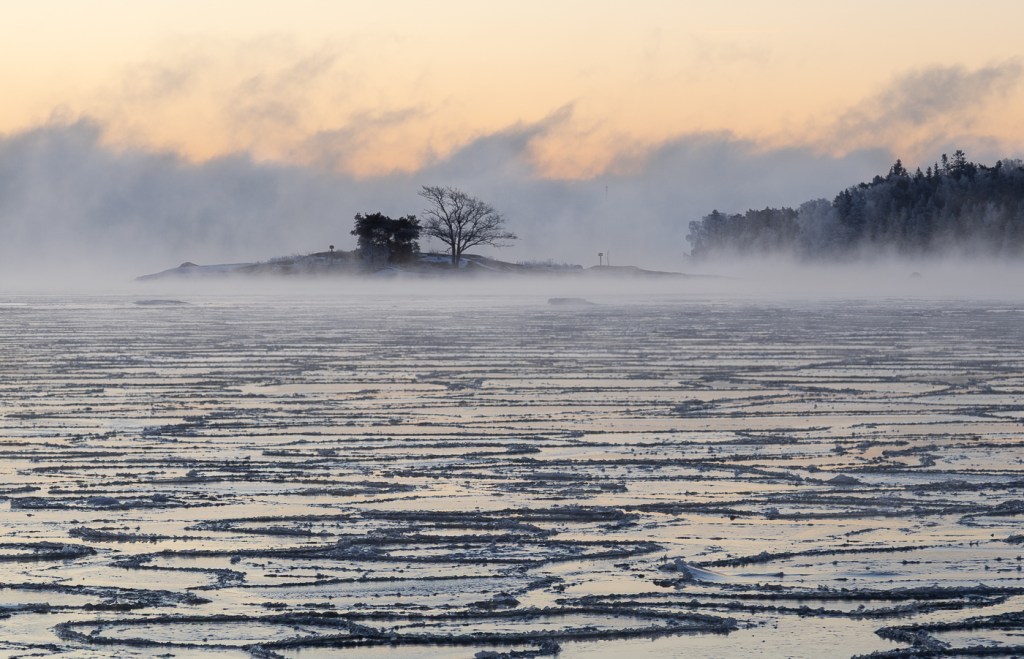
Before sunrise, the light was cold, quiet and restrained. The sea smoke softened the outlines of the landscape. Distant islands seemed to hover between sea and sky.
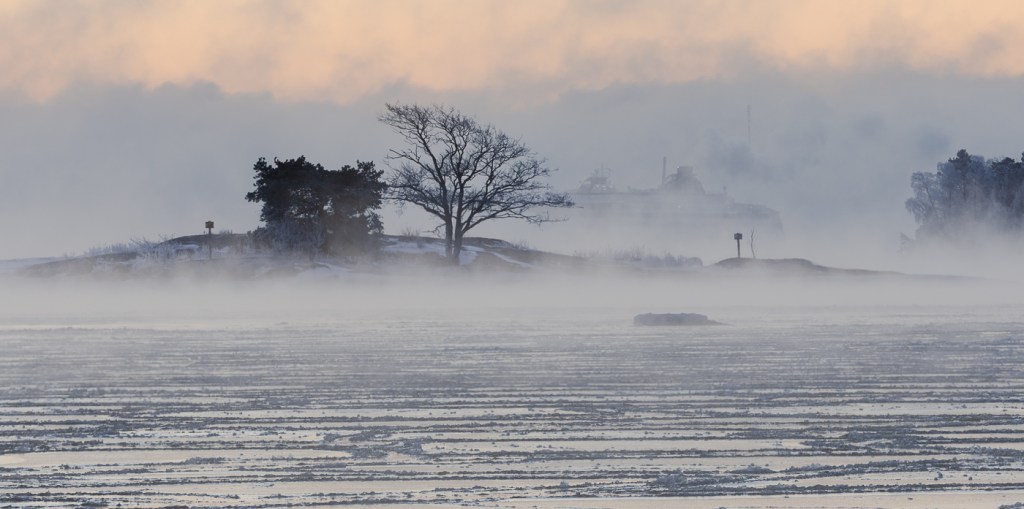
Everything felt hushed, as if the cold had slowed the world down.
After the Sunrise
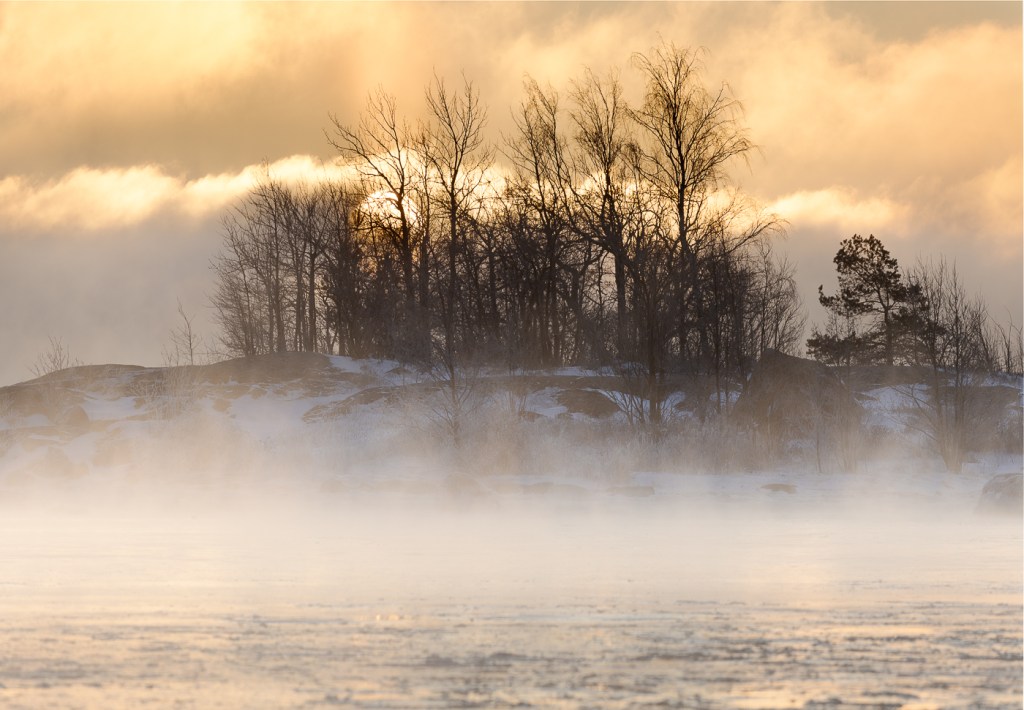
As the sun began to rise, the mood changed quickly. Light filtered through the steam, and the sea surface reflected soft, golden tones.
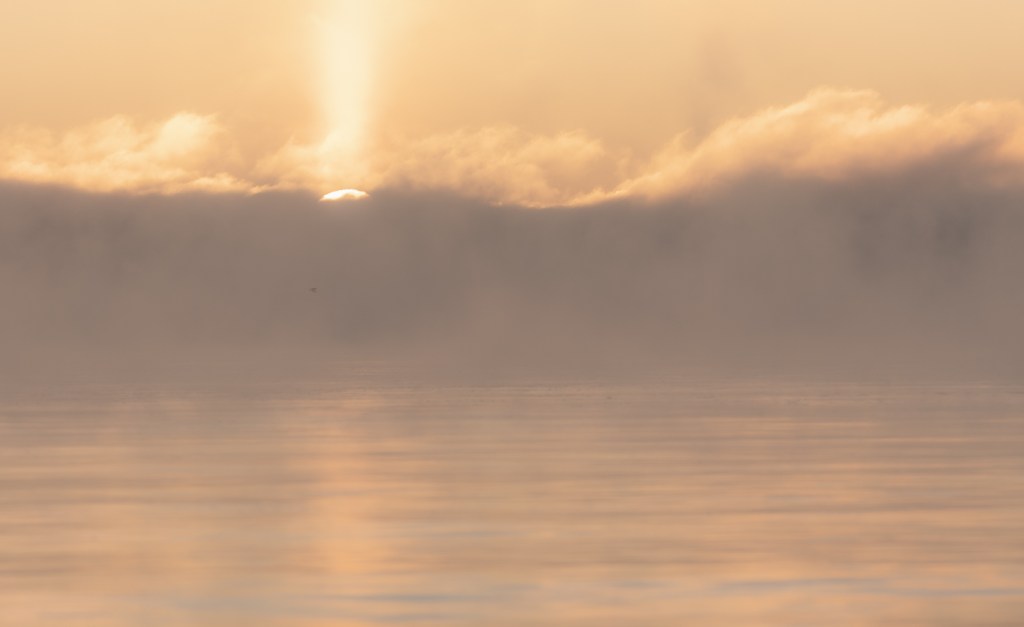
Within minutes, the entire scene transformed. Islands, trees and drifting mist emerged layer by layer, glowing warmly against the frozen sea.
Mute Swans
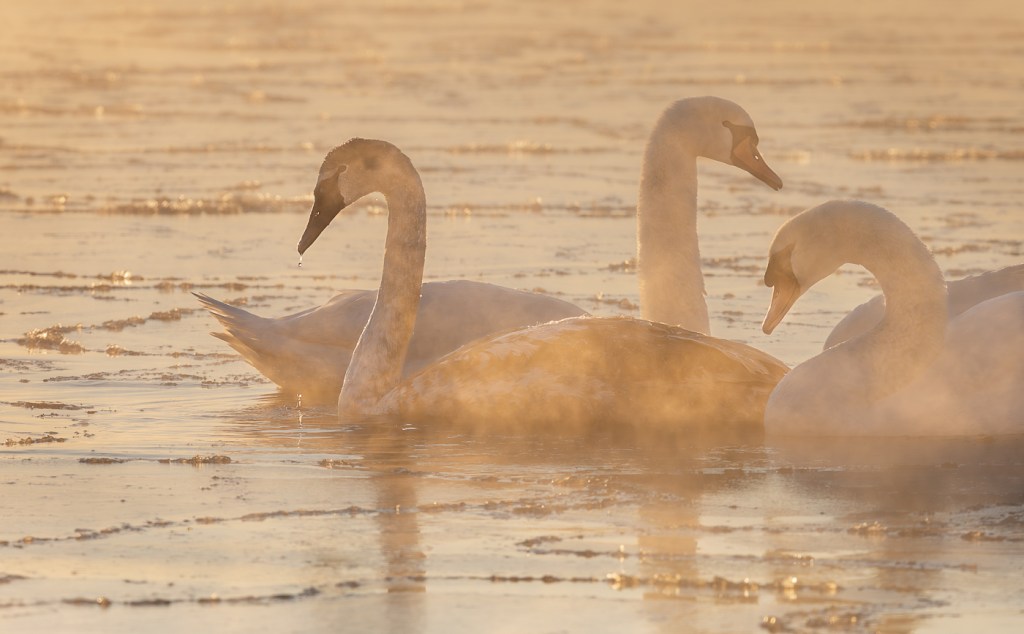
Along the shoreline, whooper swans were feeding calmly in the shallow water. There were two or three families. Wrapped in steam and early morning light, they exuded a gentle sense of life.
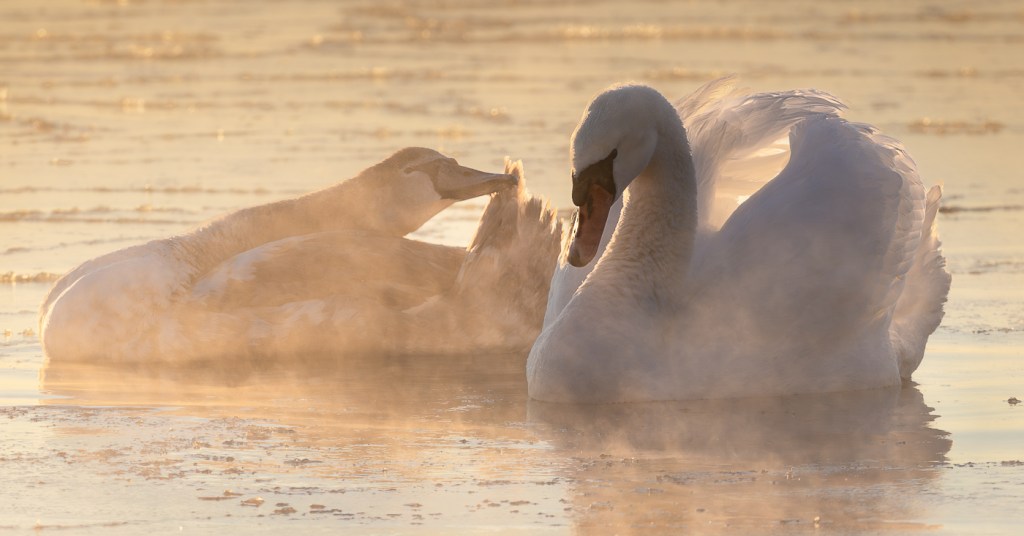
Seen from a slightly wider perspective, the swans became part of the landscape. They were no longer the main subject. This change reinforced the quiet balance between wildlife and the environment.
Facts about Mute Swans
It is one of the most iconic species of the Nordic wetlands and coastal areas. Large, vocal and strikingly white, mute swans are a familiar sight in Finnish nature, especially during spring and autumn migration.
Mute swans are known for forming long-term pair bonds, often staying with the same partner for life. Families tend to remain together outside the breeding season. Young birds may stay with their parents through their first winter. Juveniles can often be recognized by their grayer tones, which gradually fade as they mature.
In Finland, whooper swans breed on lakes, wetlands and quiet coastal areas. As winter approaches and waters freeze, most migrate south or southwest. Finnish whooper swans typically spend the winter in Denmark, southern Sweden, Germany, Poland. They may also spend the winter in parts of the Baltic Sea region. This depends on ice conditions and food availability. In milder winters, some individuals may remain closer to Finland if open water is available.
Color or Black and White?
As the light strengthened, the sea smoke itself became more expressive. In strong backlight, steam rose and curled above the water, blurring the boundary between sea, air and sky.

These moments felt almost abstract, constantly changing and impossible to fully predict.
Some scenes felt better suited to black and white. Removing color allowed the focus to shift toward shape, structure, and rhythm. Steam moves across the surface of the sea and reveals only fragments of land at a time.
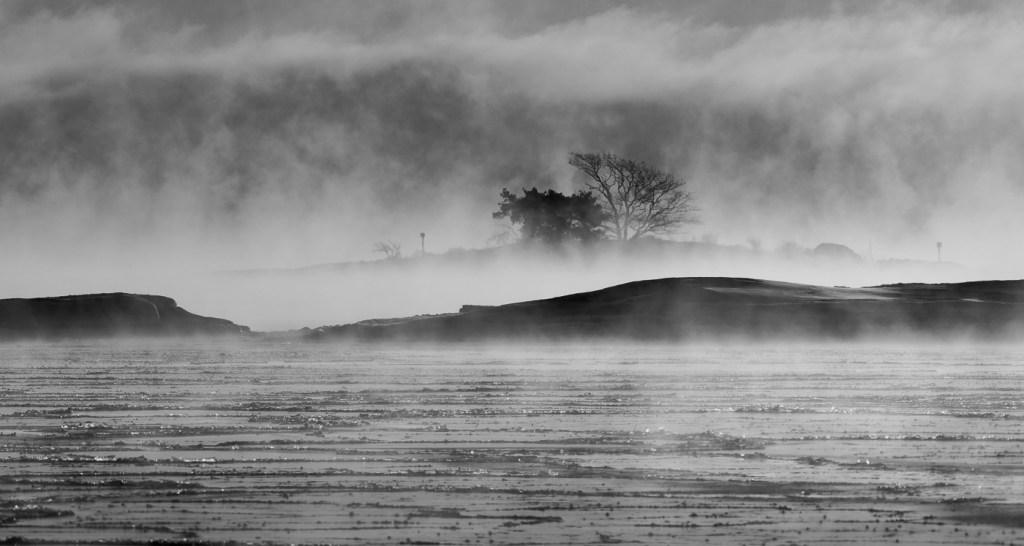
In another moment, a lone human figure stood on the ice, while the nearby swan accompanied him. This introduced scale and quiet narrative into the frame.
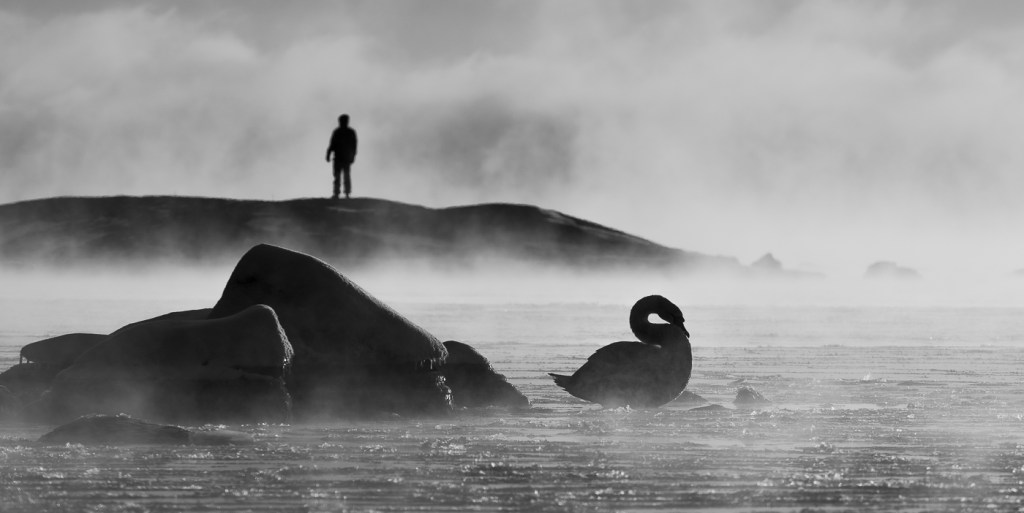
The final images of the morning moved even further toward abstraction. Steam, shadow and light merged into simplified forms, where the cold stripped the scene down to its essentials.

What to Wear When Photographing for Hours in Extreme Cold
Photographing in −20°C is not about enduring discomfort; it’s about preparation. When the goal is to stay outside for several hours, clothing becomes part of the photographic process.
I start with a merino wool base layer. It keeps me warm and comfortable even when standing still for long periods. On top of that, I add a warm wool sweater and down trousers or heavily insulated winter pants. For outer layers, I wear a long winter coat. I often combine it with a down vest to add extra insulation around the core.
Well-insulated winter boots, sometimes with heat packs, are essential, as is a warm hat that fully covers the ears.
The most critical part is always the hands. I use two pairs of gloves: thinner ones for operating the camera and thicker mittens for pauses between shooting. Hands usually feel painfully cold at first. However, in my experience, the body gradually adapts. This is true as long as you don’t let yourself get too cold.
One practical detail not to forget is the camera battery. In these temperatures, I always keep spare batteries close to my body. For example, I store them in an inside pocket to preserve their performance.
Editing Choices: Color and Black & White
When editing this series, I considered what each image needed rather than following a single rule.
In color images, I emphasized the warm golden tones. I kept saturation and contrast controlled. This approach allows the steam and mist to remain soft and airy. For black and white conversions, the goal was to highlight form, texture and depth. This was especially true in scenes where color would distract from the underlying structure.
Both approaches felt equally important in telling the story of that morning.
The Reward of the Cold
Photographing in −20°C is demanding, but it offers moments that only appear in extreme conditions. Sea smoke, ice and winter light came together in Lauttasaari in a way that felt both fragile and powerful. With the right preparation, the cold becomes part of the experience. It is not an obstacle, but a collaborator.
Winter photography often requires working at the edge of comfort. However, it provides moments that exist only briefly. These moments appear only in the cold. If you photograph in winter too, I’d love to hear about your experiences. How do you prepare? What have you learned? What are the small details that make cold days easier in the field? Feel free to share your own tips or stories in the comments.
Thank you for visiting my blog. I hope you enjoyed this post and found something useful or inspiring along the way. If you’d like to follow my work, you’re very welcome to subscribe and join me on future photographic journeys.
 MINNA JACOBSON
Extraordinary photos! Each one captures such amazing scenes! And such lovely swans as well! I have never seen pancake ice or sea smoke before.
LikeLiked by 1 person
Thank you Magickmermaid for your kind comment. Sea smoke is seen quite seldom. This was my fourth time, every time has been huge experience.
LikeLike
Frost, swans, morning light and silence! Just wonderful. Black and white is very effective though that morning light was so beautiful, I this instance I think that is my preference. But both sets of photographs are stunning.
LikeLiked by 1 person
Thank you! The morning light was truly beautiful, and I completely understand your preference for the colour version. Black and white felt more about mood and form. I’m glad both spoke to you.
LikeLike
These are stunningly beautiful photos, Minna. Yes, I did spot the ship. I understand about the cold preparation. I lived and worked at 62.5° N latitude in Yellowknife, NWT where winter temperatures regularly drop to -40C. Wearing the tight clothes for the conditions is essential.
LikeLiked by 1 person
Thank you Lynette for your kind comment. We have had in the South Finland sometimes even -30 C. You can stay out, but not very long time. This winter it has been over -40 C in Lappland… Even that is extreme temperature, I must experience that some day.
LikeLiked by 1 person
Beautiful conditions and images.
LikeLiked by 1 person
Thank you Kewtie🤗 It was wonderful morning 🌞🌞
LikeLiked by 1 person
Stunning images yet again.
Your Whooper Swans are what we call Mute Swans. The Whoopers we get have yellow wedges on the bills and come from the far north to winter.
LikeLiked by 1 person
Thank you, I really appreciate that! And thanks for pointing it out these are Mute Swans. Whooper Swans are a bit different, with the yellow on the bill, and they migrate from the far north to spend the winter here. And Whoopers are our natinal bird, so that’s correct.
LikeLike
love yor work
LikeLiked by 1 person
Thank you, Shelly! That is really kind of you, I truly appreciate it.
LikeLike