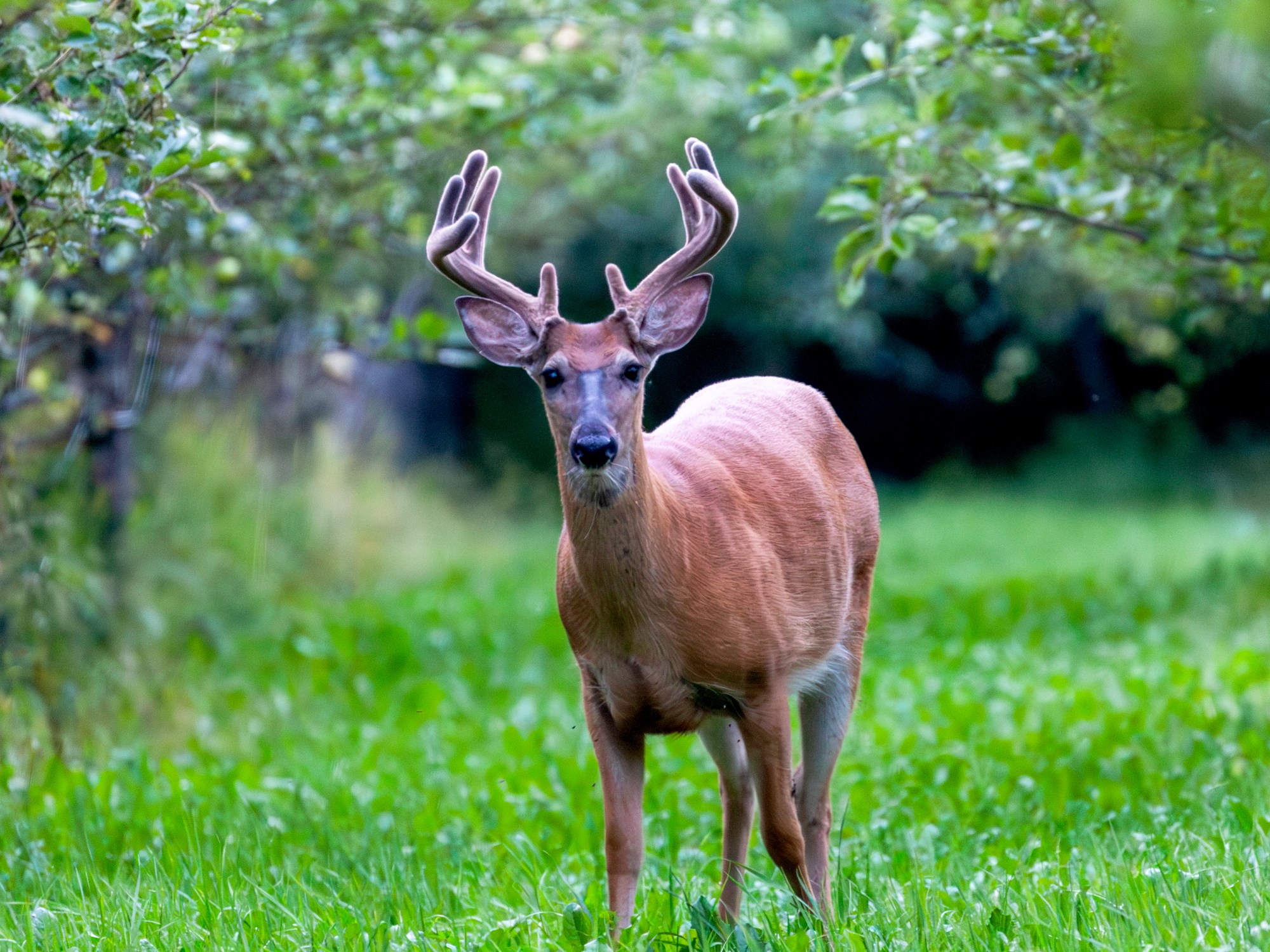
With this post, I want to highlight how an alien species can disrupt a natural ecosystem. Those who introduced the white-tailed deer to Finland likely had good intentions, but they may not have realized that a species that doesn’t naturally belong in a new environment can wreak havoc. Many people closely involved with deer hope that they would be completely removed from Finland’s nature, much like other invasive species.
In Finland, however, hunters have taken a different stance. Instead of eradicating white-tailed deer, they feed them and now want to cull 300 protected lynx to ensure that the deer population remains high, providing ample hunting opportunities. It’s difficult for me to understand how this is allowed to happen.
White-tailed deer is non-native species in Finland
White-tailed deer, native to North and Central America, made their way to Finland in the 1930s, thanks to American immigrants who wanted to share the gift of a beautiful game animal with their old homeland. The first five of these deer arrived in Finland in 1934, with the goal of opening up hunting opportunities and enriching local ecosystems with a touch of biodiversity.
The entire population of these deer can trace its roots back to those early arrivals in Laukko. In the grand tapestry of Finnish wildlife, white-tailed deer take second place, just behind the mighty moose, when it comes to their importance as game animals.
Increasing deer population in Finland
Despite this being a sight I had never seen before, I’m concerned about the increasing deer population. The most recent estimate from the Natural Resources Institute of Finland puts the white-tailed deer population at approximately 109 000. However, during the hunting season of winter 2021-22, about 74 000 were harvested, resulting in a slight decrease in their numbers.
As the deer population continues to grow, white-tailed deer have boldly ventured into suburban areas, finding their way into gardens where they sometimes treat themselves to a garden buffet, nibbling on flowers, plants, and trees. Not only gardens they cause damages to crops and wild plants as well.
Having encountered these visits, even in my own garden in Lohja, I’ve developed a love-hate relationship with this beautiful animal. It can be quite frustrating to plant new trees, only to return to the garden the next time and find them devoured, leaving the trees struggling to thrive.
Furthermore, there’s significant concern when white-tailed deer visit people’s gardens, as they can carry ticks. These ticks can be transferred to new areas, contributing to the spread of tick-borne diseases, which can have health implications for both humans and other animals.
Lucky encounter with a white-tailed deer in the apple orchard
Despite my critique of white-tailed deer in Finnish nature, here are some photos of a courageous male deer I encountered a few years ago, in a picturesque apple tree orchard in Lohja.
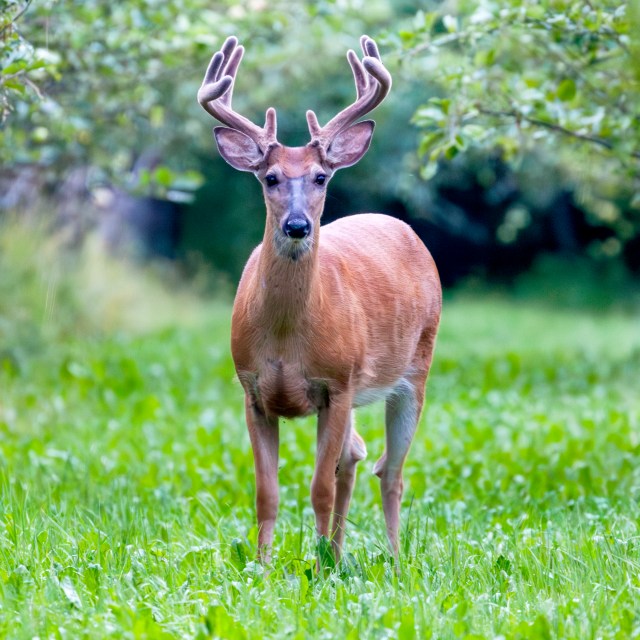
We were driving past the garden when I spotted this noble stag among the apple trees.

It was an amazing sight, and I was fortunate to have my camera at hand to capture its presence.
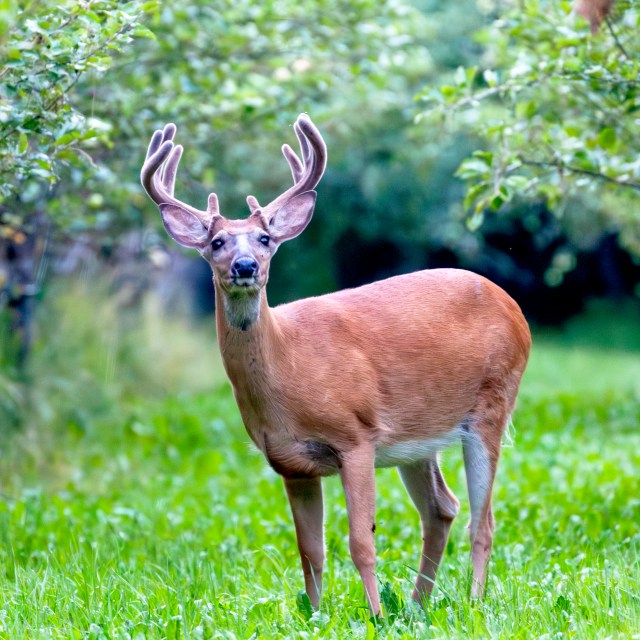
The deer seemed to be looking for our car, but perhaps it didn’t notice us, giving us a great opportunity for photography.
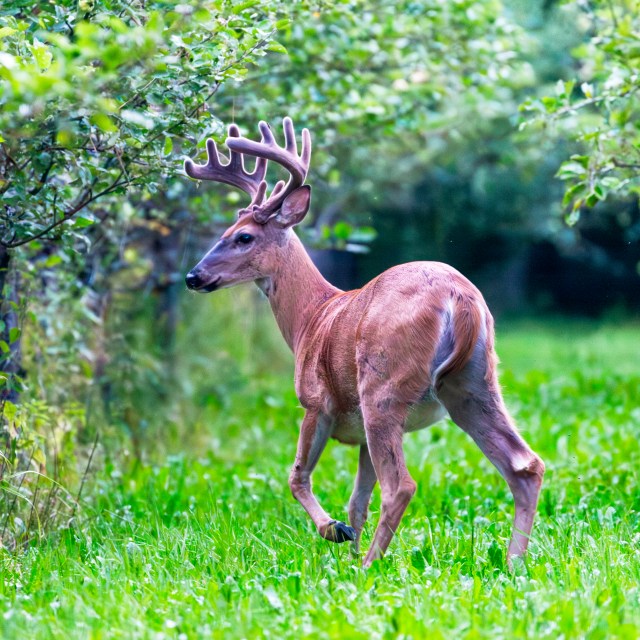
In just a few minutes, the graceful creature turned and vanished into the surrounding forest.

The introduction of non-native species like white-tailed deer can disrupt local ecosystems and upset the balance of native wildlife. Because of this, the Finnish Association for Nature Conservation proposes adding the white-tailed deer to the list of harmful alien species by 2030. The reason is that the species causes numerous traffic accidents, damages to crops, gardens, and wild plants, and spreads ticks.
Thank you for visiting my blog and reading my post on white-tailed deer. I’d love to hear your stories about encounters with white-tailed deer and whether they pose similar challenges in your country.
See you around,
Minna from Finnish Nature
 MINNA JACOBSON
I agree with all that you wrote.
LikeLiked by 1 person
Thank you 😊
LikeLiked by 1 person
Whenever I come across an animal I try not to move. Moving freaks them out as they then realize I am another animal.
Great shots!
LikeLiked by 1 person
Thank you, I was lucky to be inside the car. It is true that when an animal or bird realise that a human is nearby, they leave immediately.
LikeLiked by 1 person
I am definitely not a fan of introducing non-native wildlife (or fauna) into new ecosystems – it never works out for the best and the side-effects can be horrendous. White-Tailed are native here and in fact we live in what is referred to as “Big Buck” territory here in the Midwest. They are quite wonderful to look at, but they can do some serious damage to your landscaping.
LikeLiked by 1 person
I completely understand your perspective on not introducing non-native wildlife into new ecosystems. You’re absolutely right; it often leads to unforeseen consequences and can have serious side-effects on the environment.
White-tailed deer, being native to your area, are indeed magnificent creatures to observe. However, their impact on landscaping and gardens can be quite challenging. It’s a delicate balance between appreciating their beauty and dealing with the damage they can cause to your property. Living in ‘Big Buck’ territory must offer some incredible wildlife viewing opportunities, though.
Thanks for sharing your thoughts on this matter. It’s essential that we consider the potential consequences of our actions when it comes to introducing or altering ecosystems.
LikeLiked by 1 person
How I wish people would not mess about with Nature, particularly introducing animals that are not native to the area. We have white-tailed deer here and there always seem to be more deer than the land can support, so they visit crops and gardens. My rose of Sharon bushes are apparently favourite food of the deer and I cannot blame them when mankind has taken away all their habitat. I particularly hate that animals are introduced for the pleasure of people hunting. All very well, years ago, when it was necessary to feed oneself but as sport? I have never been able to understand how anyone can derive pleasure from killing a wild animal. Your pictures of the stag are wonderful. We don’t often see males here, so I get quite excited if I see antlers. 3 years in a row we had fawns born in the field I own, once it was twins! But not these past 2 years. It was a privilege. One never takes these things for granted!
LikeLiked by 1 person
I completely agree with you, and I share your sentiments about how people sometimes interfere with nature. It’s unfortunate that introducing non-native animals can disrupt the local ecosystem and create challenges for both wildlife and people. I’m sorry to hear about the deer visiting your crops and gardens, and I understand your frustration, especially when their natural habitat has been diminished.
I also share your concerns about hunting for sport, especially when it’s no longer a necessity for survival. It’s hard to understand how anyone can find pleasure in taking the life of a wild animal.
I’m glad you enjoyed the pictures of the stag. It’s always exciting to see these majestic creatures, and your experience with fawns being born in your field sounds like a wonderful privilege. Nature’s beauty and its creatures are indeed something we should never take for granted.
LikeLike
Invasive species are never a good thing. Fantastic photos.
LikeLiked by 1 person
Thank you Lynette! As you say it is never good when people destroy natures ecosystem.
LikeLiked by 1 person
While our garden was unfenced, it was a favorite grazing spot for all the wild animals. We most often see the forest deer, which is much smaller than the white tail of your post. But, we’ve seen them. Along with a host of other wildlife including mink, stoat, badger, fox, hare, and raccoon dog. Birds of prey all the way down to the smallest songbird.
Fencing solved almost all the unwanted grazing issues. Hares are good at finding a gap in the fence near the ground, so their visits are still recurring from time to time.
I agree that the culling of the lynx is appalling and wonder why that approach has been taken. so much of our modern world is topsy-turvy and doesn’t equate.
LikeLiked by 1 person
Thank you for your comment, Kate. It’s great that you’ve managed to keep the wild animals out of your garden. It’s really not pleasant when, for example, yew bushes are gnawed down to the ground in winter. Last winter, a hare destroyed my Japanese maple in the garden, which was really frustrating. There’s really no sensible reason for killing lynxes. The Finnish Association for Nature Conservation has raised money for the legal expenses because they’re taking the hunting permits to the Court of Appeals. I saw on Instagram that they’ve raised 52 000 euros. That’s fantastic!
LikeLiked by 1 person
Beautiful photos! I agree entirely with everything you mentioned.
Humans have destroyed the ecosystem in almost every way possible. Introducing alien and defenseless animals for the purpose of hunting has to be one of the worst fiascos.
LikeLiked by 1 person
Thank you Magickmermaid! It’s really unfortunate that white-tailed deer were introduced here at some point, and that their population growth wasn’t controlled soon enough. Now, especially here in southern Finland, we have massive problems with deer. The biggest issue is the spread of ticks. I agree that people should not destroy ecosystem in any way.
LikeLiked by 1 person
Had no idea about this problem in Finland. Fortunately, no one has had the same idea in Sweden, but there are other implanted mammals that cause major problems, the wild boar in particular. It rarely turns out well when humans play with natural selection. One who blogs a lot about this thing called rewilding is Gustaf at gustafredemo.com, take a look.
LikeLiked by 1 person
Thank you Hans, I will Check Gustaf’s blog.
I’ve read in the news that you in Sweden are facing a big issue with wild boars. Don’t they also have African swine fever now?
It’s really unfortunate when the natural ecosystem gets disrupted. Usually, that doesn’t lead to anything good.
In Finland, we have problems with white-tailed deer, especially in the southwest and southern parts. They spread ticks, and for example, in our backyard in Espoo, there are ticks. Espoo is, after all, the second-largest city in Finland, but we still have deer roaming in our yard 🙂
LikeLiked by 1 person
Here in the American South the white tailed deer has become a pest. It is estimated that the deer population in Alabama is between 1.2 to 1.5 million. They are native and they are beautiful. As the deer numbers have increased, coyotes have moved across the Mississippi river into the South. Both of these animals are now seen in urban areas. The coyotes will kill domestic dogs and cats if they are hungry. The deer population has increasingly been seen in urban areas as they seek food. Of course, while they are there they will eat most anything growing in the garden.
They seem not to mind humans and it is easy to photograph them as you have done.
The problem is severe enough that the state issues hunting permits to bow hunters in some state parks to try to control the deer population. Deer tick born disease has not been significant as far as I know. The deer overpopulation makes them susceptible to diseases that will eventually “thin the herd”. An example of this is chronic wasting disease CWD which has now been seen in our state. No threat to humans but a highly contagious disease for the whitetail.
LikeLiked by 2 people
Wau, 1.2 to 1.5 million deer living in American South. That is a huge number.
White-tail deer are undoubtedly native in America, but as you mentioned the rapid increase in their population has led to several challenges. The coexistence of deer and coyotes in urban areas does not sound nice, especially as coyotes are hunting domestic animals.
As the population of deer in Finland grew, in the ministry level they decided to kill over 70% of the population and it had positive impact. Hopefully you can reduce the number of deer as well.
Though Nature often has its own mechanisms for regulating animal populations. In the case of deer and other wildlife, when their populations become too large, natural factors like disease outbreaks, food scarcity, and predation can come into play to help control their numbers. Chronic wasting disease (CWD) is one such natural mechanism that affects deer populations.
Thank you for sharing this information; it’s a reminder of the complex challenges that can arise when dealing with wildlife populations.
LikeLiked by 1 person