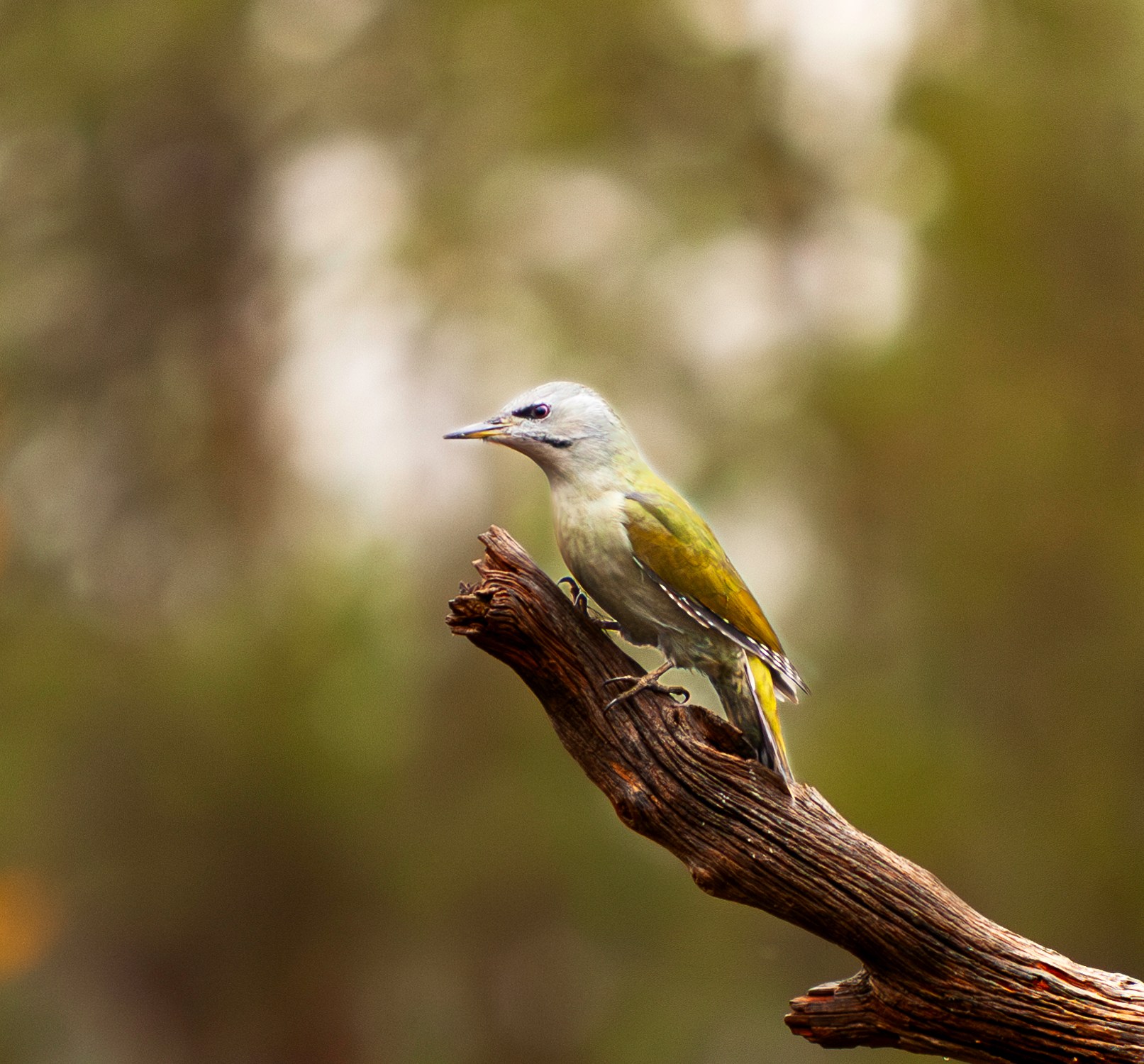
In Finland we have seven species of woodpeckers. The resident species include the Great Spotted Woodpecker, Lesser Spotted Woodpecker, White-Backed Woodpecker, Black Woodpecker, Eurasian Three-Toed Woodpecker, Eurasian Wryneck, and Grey-Headed Woodpecker. Globally, there are around 200 species of woodpeckers across 30 different genera.
I have a deep fascination for woodpeckers. Among the seven remarkable species found in Finland, I’ve been fortunate to encounter four and capture the elusive great spotted woodpecker, the charming grey-headed woodpecker, and the striking black woodpecker through my lens. Photographing these captivating birds is not just an art; it’s a delightful challenge. Woodpeckers are naturally vigilant creatures, making them intriguing photographic subjects.
My woodpecker adventures took me to the picturesque landscapes of Kuusamo, Finland, where I set up my camera in well-concealed Kuusamo Nature Photography photo hides during the enchanting springs of 2022 and the alluring falls of 2023. These photo hides allowed me to observe woodpeckers up close in their natural habitat.
Woodpeckers – Nature’s drummers
Woodpeckers are known for their distinctive behavior of drumming on trees in search of food. They have evolved to withstand the impact of their powerful drumming without injuring themselves, thanks to various anatomical adaptations and physiological features.
Woodpeckers are well-known for their robust beaks, which they use to chisel out food from within trees, excavate nest cavities, and engage in courtship displays. In the spring, they seek out trees that produce a loud resonant sound and advertise themselves by drumming instead of singing.
Woodpeckers possess a reinforced cranial shield that protects their brains from the forces generated during drumming. Their skull bones are thicker and denser compared to most other birds. Additionally, woodpeckers have specialized tendon and muscle systems that help absorb the shock of drumming, distribute the force, and reduce the risk of injury.
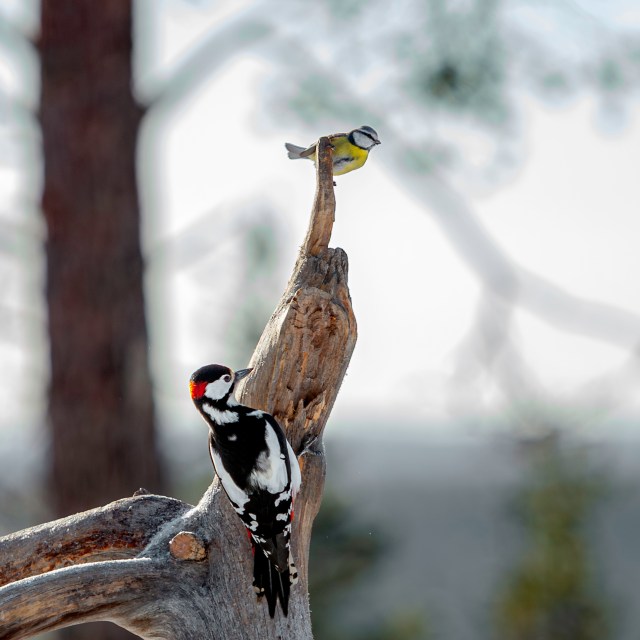
Great Spotted Woodpecker
Great spotted woodpecker females have an all-black crown, while males sport a red nape, and young birds have a red crown.
Great spotted woodpeckers drum on dead or dying tree trunks and sometimes lamp posts equipped with metal shields. By tapping on the metal, male great spotted woodpeckers invite females and advertise their territory, simultaneously waking up the entire neighborhood.

At our cabin in Lohja, I regularly encounter great spotted woodpeckers at a feeding site.

In winter, great spotted woodpeckers feed on pine cone seeds, which they open in a “cone workshop.” During other times of the year, their diet is more diverse, including insects and sometimes even the nestlings and eggs of other birds.
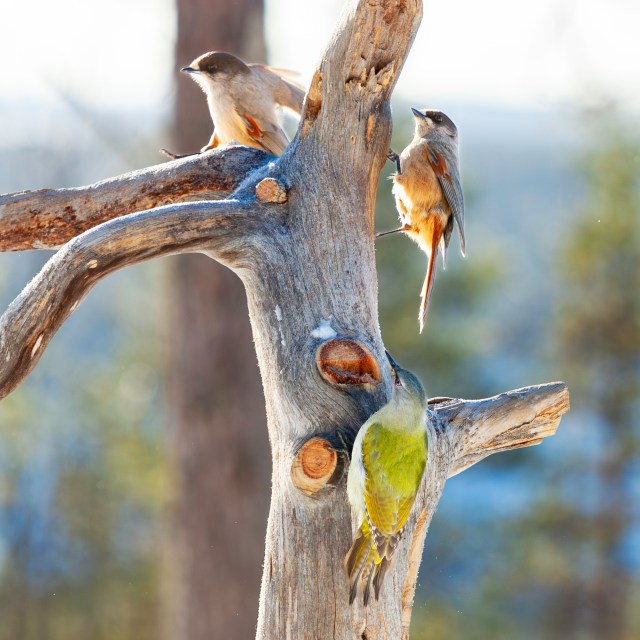
Grey-headed woodpecker
The Grey-Headed Woodpecker is the second-largest woodpecker species in Finland. It is an impressive bird in terms of size and coloring, with its name derived from its gray head. I’ve always found the naming of this bird intriguing because it boasts a magnificent green plumage, yet its head takes the spotlight when it comes to naming.

This woodpecker inhabits a variety of forest environments. Its primary diet consists mainly of ants and their eggs and larvae, although it also consumes other insects. Consequently, it searches for food on the ground almost as often as in trees.

The grey-headed woodpecker frequently explores decaying tree trunks and stumps, picking up insects hidden beneath loose bark or within cracks.
Black woodpecker
The Black Woodpecker is the largest of all European woodpecker species. Like other woodpeckers, it is an alert, vigilant, and curious bird. The black woodpecker breeds throughout our country, extending to the boundaries of the coniferous forest zone. But you don’t see them often as they live on old forests, which nowadays are not so common in our country.
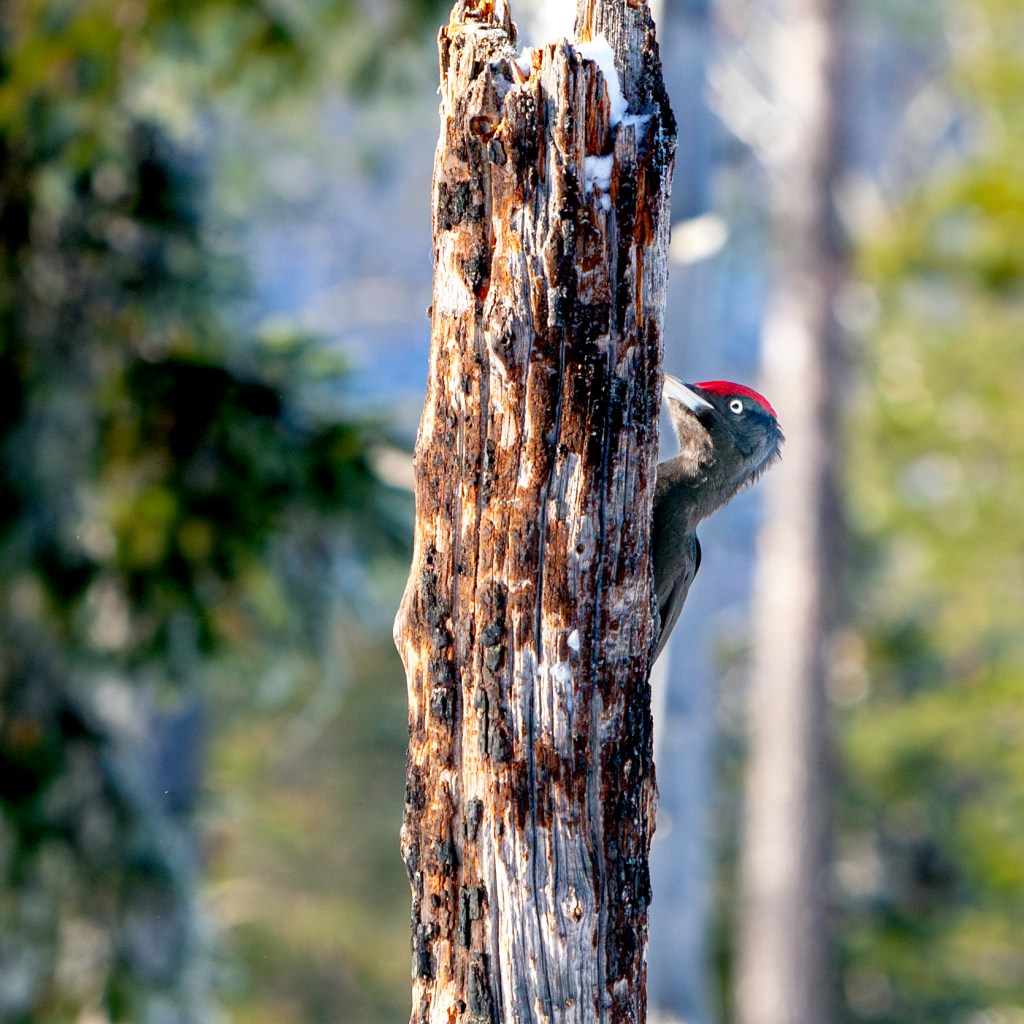
Its diet includes horse ants, wood ant larvae, beetle larvae, and other insects, occasionally even berries such as blueberries. While the Black Woodpecker is capable of chiseling living spruce trees to find food, it typically investigates stumps, dead trees, and fallen logs when foraging.
Almost every spring, woodpeckers carve out new nest holes for their offspring, which has a significant impact on forest ecology. Old nest holes are not left vacant and can be used by various other cavity-nesting birds, such as coal tits, redstarts, and tawny owls. Even flying squirrels may inhabit woodpecker holes. Large black woodpecker holes may house species like common Goldeneyes and Tengmalm’s Owl.
Woodpeckers are not just charismatic birds but key players in the complex web of life in forest ecosystems. Their activities contribute to the balance and health of these ecosystems, and their role in controlling insect populations and creating habitat structures has far-reaching effects on biodiversity and forest stability. Understanding and conserving these woodpecker populations is not just about preserving one species; it’s about preserving the intricate web of life within forests.
I hope you enjoyed reading my woodpecker post. I would love to hear your stories about woodpeckers in your country or any interesting woodpecker experiences you might have.
Minna from Finnish Nature 🙂
 MINNA JACOBSON
I adore all birds but I have a particular fondness for woodpeckers. Yots are wonderful. The grey-headed so unusual. I have never seen a yellow one, although flickers I believe have yellow under their wings. In Washington State we saw the big pileated often as well as flickers. Here in New York they exist but we see them rarely where I am. There was another large woodpecker called ivory-billed buy sadly it was declared extinct last year. Is it too much to hope that in some remote spot a few still live? Other animals thought to be gone have re-appeared. Mostly in Upstate NY we have the hairy woodpecker, the downy and the red-breasted. I think your male black is similar to the pileated. A big bird with quite a beak! I love to hear them drumming on the trees. We see their work on many of our trees. I love seeing your photographs and reading about trips to your cabin.
LikeLiked by 1 person
Thank you for your heartfelt comment! I share your love for woodpeckers, and they truly are fascinating birds. The variety you’ve encountered, from the Yots to the unique grey-headed ones, is remarkable. The yellow underwing of flickers is a charming feature, and I’m sure it adds to the appeal of these birds.
It’s both wonderful and bittersweet to hear about your woodpecker encounters in different locations. The sight of the pileated and flickers in Washington State must have been a treat, and I can understand the rarity of these sightings in New York. The sad news about the ivory-billed woodpecker’s extinction is a reminder of the importance of conservation efforts.
I’m delighted that you enjoy my photographs and stories. Sharing these experiences and connecting with fellow nature enthusiasts like you is a true pleasure. Your appreciation and love for these birds and their environment is heartwarming. Thank you for your kind words, and may you continue to enjoy the wonders of the natural world!
LikeLike
I love the shots!
I have a theory about Woodpeckers. I think they peck at a dead tree to see If anyone is home? Meaning,If there are any insects the pecking disturbs them ,making them move about making sounds and then the Woodpecker can hear them! It knows exactly where to dig!
LikeLiked by 1 person
Thank you! A really interesting theory, and you’re probably right! Well thought out 🙂
LikeLiked by 1 person
I’ve noticed that they stop pecking as If to listen!
LikeLiked by 1 person
😊👌
LikeLike
Well captured and well explained. Love the Harmaapäätikka!
LikeLiked by 1 person
Thank you! My favourite is palokärki, but I am fond of harmaapäätikka as well 😊
LikeLiked by 1 person
Beautiful beautiful birds, and wonderfully captured. Thank-you for sharing…
LikeLiked by 1 person
Thank you much and you are wellcome.
LikeLiked by 1 person
There are 12 species native to British Columbia; the most common are pileated, downy and white-headed. Many stay all winter, but especially the northern flicker. They are so lovely to watch.
LikeLiked by 1 person
Thank you Lynette for your reply. I think that pileated looks a little that our black woodpecker and actually downy like our white-backed woodpecker. But white-headed is very special and we don’t have anything like that in Finland. It was nice to compare your woodpeckers to ours. I enjoy watching birds and photograph them 🙂
LikeLiked by 1 person
Of course, we’ve seen them frequently here, but I’m not a birder, so I don’t know which they are. Most go about their business on the trees, but occasionally there’s the one which prefers hammering on a light post for some reason!
For me, Minna, I’m most captivated by the cuckoo bird. We didn’t have those where I grew up, so hearing them here was really magical. At least I *think* it was a cuckoo – sure had the trademark bird call! 🙂
LikeLiked by 1 person
It’s always fascinating to have a variety of birds around. The sight of them going about their activities in the trees or, in the case of the one that enjoys hammering on a light post, adds a touch of whimsy to our daily lives. They are actually drumming to invite female to approach them 🙂
I completely understand your fascination with the cuckoo bird. Their distinctive call is indeed quite magical, and it’s often the unique sounds of birds that capture our attention and make them stand out. Birds have a way of bringing joy and wonder to our surroundings. 😊🐦🌳
LikeLiked by 1 person
Really like that grey-headed variety – unlike any here in the States. Great shots.
LikeLiked by 1 person
Thank you so much!
LikeLike
I also love woodpeckers. What a treat to see so many varieties! I see mostly the great spotted woodpecker here, and hear them too. We have green woodpeckers but I rarely see them, although we hear them from time to time. Great post!
LikeLiked by 1 person
I agree, woodpeckers are truly fascinating birds! It’s a real treat to spot the different varieties. Thanks for enjoying the post!
LikeLiked by 1 person
Magnificent photos of these beautiful birds! I always learn something new here! 🙂
LikeLiked by 1 person
Thank you Magickmermaid! I am happy to hear that 🙂
LikeLike
Lovely images! We have the Green Woodpecker (picus viridis) and this is why I think your bird is called Grey-headed so no confusion in species.
LikeLiked by 1 person
Hmm, it might be the reason. Thank you for your comment 😍
LikeLiked by 1 person