
Moose, known as “hirvi” in Finnish, are an iconic part of Finland’s wildlife. They’re the largest species in the deer family and are commonly found in the forests and woodlands throughout the country.
A few years back, I was driving back to our cabin on a warm mid-July night, around eleven o’clock. The sun was setting, but the sky still held a gentle glow. The fireweeds looked stunning in the dimming light, and in the middle of the field, I noticed a moose.
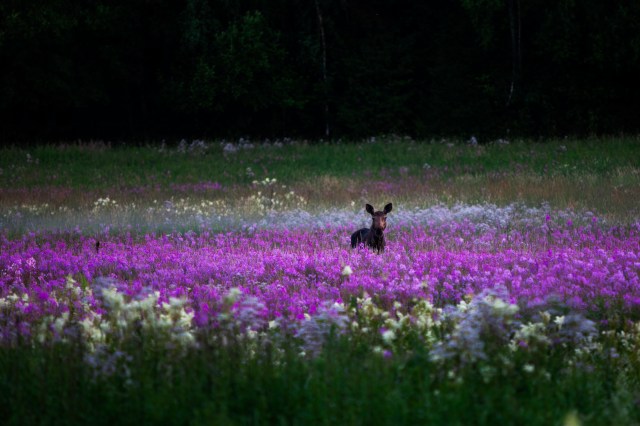
With the light fading, I pulled over and stepped out of my car with my camera in hand. The moose and I locked eyes. It wasn’t until later, when I was editing the photo, that I realised it was a mother moose with her calf. By the way can you find the calf in the photo? I give you a hint: Take a close look at the picture, and you’ll find the calf’s ear in the image.
Population and habitat
Moose are primarily found in the northern parts of Europe, North America, and Asia.
In Europe moose are commonly found in countries like Sweden, Norway, Finland, Russia, Latvia, Estonia, and Poland, inhabiting boreal and mixed forests. On the other side of the world moose are prevalent in Canada and Alaska, with populations also found in parts of the northern United States, including states like Maine, Minnesota, and Montana. Moose are also found in parts of Mongolia and China. In these areas, they inhabit taiga forests and wooded landscapes.
The estimated total moose population worldwide is roughly between 1 to 1.5 million individuals. In Finland the moose population is estimated to be around 77 000 individuals. The density of moose is higher in the central and northern parts of the country, especially in the forests.

Moose prefer habitats with ample vegetation, such as boreal forests, mixed woodlands, marshes, and areas with abundant aquatic plants. They are adaptable animals but thrive in areas with a mix of dense forests and open spaces where they can find suitable forage.
Finland’s vast forests, which cover over 70% of the land, provide ample habitat for these majestic creatures.
Behavior
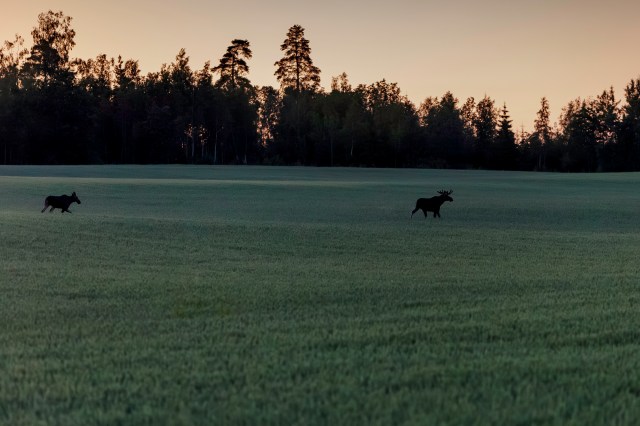
After capturing the moose standing in the fireweed field, I continued my journey and spotted two more moose approaching the road. It was a male and a female, moving steadily through the wheat field, heading towards the road.
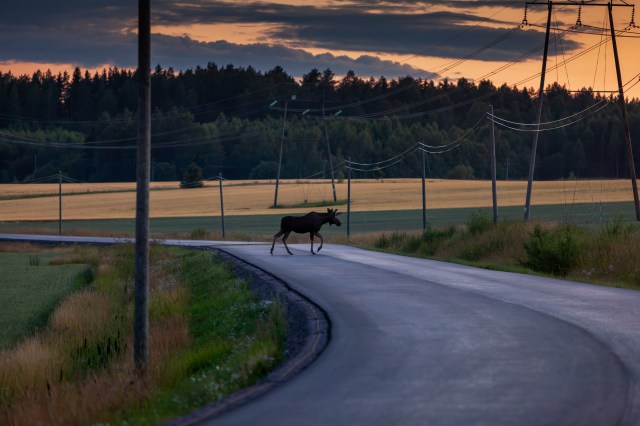
The sun had set, painting the sky a beautiful shade of orange. I pulled over, stopped my car, and once again, hopped out. I wasn’t sure if there was enough light for photos, but I decided to give it a try anyway. And luckily I could get images of there magnificent animals.

Moose tend to be active around dawn and dusk, but they can also be spotted during the daytime. In the summer, they often frequent wetlands and marshes to graze on aquatic plants.
During winter moose are growing thick fur. Their broad hooves aid in traversing snow-covered terrain, allowing them to navigate through deep snow effortlessly.
Despite their shy nature, collisions between vehicles and moose are prevalent in rural parts of Finland. To prevent these accidents, the country implements safety measures like road signs and designated wildlife pathways.
Impact
Moose can have a significant impact on the environment due to their browsing habits. They primarily feed on leaves, twigs, and the bark of trees, which can sometimes lead to damage in commercial forests.
Finland places importance on conservation efforts to maintain a healthy moose population. This involves managing hunting quotas, protecting habitats, and studying their behavior and migration patterns.

Finns hold a deep respect for nature and wildlife, including the iconic moose, and this reflects in their efforts to conserve and coexist with these magnificent animals.
Besides moose, we have also a number of White-tailed deer living in Finland, of which you can read more here: Balancing Act: White-Tailed Deer in Finland’s Ecosystem
Thank you for visiting my blog and reading my moose post. I hope you enjoyed it!
Join me on my journey in the Finnish nature! Follow my blog for more insights and adventures.
Minna from Finnish Nature 🙂
 MINNA JACOBSON
How wonderful to be able to capture those photos, especially the fireweed. I used to visit relatives in Maine and it was common to see them there. The closest I came to one was in Wyoming. I was watching the sunrise lighting up the Grand Tetons and suddenly I noticed a female moose walking down a path to a creek. Normally I would have been frightened to be so close, but I had been standing still and she ignored me. It gave me such a thrill! From all you say I think I would have been very happy living in Finland! (By the way I notice you have cats!)
LikeLiked by 1 person
Thank you for your kind comment! It must have been very exciting moment when you were so close to the moose. I am sure I would have been afraid as moose are so big 😊
You are right, I have two cats 😍 They are both Norwegian forests cats.
LikeLike
Beautiful photos and interesting post. 🙂
LikeLiked by 1 person
Thank you Lynette!
LikeLiked by 1 person
Beautiful photos! Amazing how much detail you were able to capture in low light. Especially the calf’s ear. 🙂
LikeLiked by 1 person
I’m deligted! The calf’s ear turned out to be a pleasant and unexpected surprise.
LikeLiked by 1 person
I love moose — your images with the flowers are just so beautiful. I tend to only see moose on a drive so then that can be both just a fleeting glance and a scary experience — in case they come out on the road. I had a moose lumber in front of our car in fairly high traffic volume on a major road here north of Oslo — that was really scary. The last time I saw a moose was when we were also on a major highway this past summer, heading out of town. We saw a politi van coming up on the side of the highway first before catching sight of a moose running towards a gap in the fence that would have led it right onto the highway. I was afraid for the moose (to either be hit by traffic or shot by the politi) but, fortunately, we found out not too much later that the politi were successful in stopping traffic and also heading the moose back into the forest away from the roadway. Whew. They need a moose underpass in that location (there are moose overpasses here and there — one of the first things of note I learned when I moved here long ago). Anyhoo, I like your post. Have a great week.
LikeLiked by 1 person
Thank you for sharing your story! It scary to see the moose when you are driving a car, as there is always a risk that they run into the road. The animal is so big that hitting it can cause severe damage to people. You too, have a great week!
LikeLiked by 1 person
Great encounter! We love to see Moose in the field..problem is being able to find them. They are further west of us hear in the heartland, but we do happen upon them while in Yellowstone and the grand tetons.
LikeLiked by 1 person
Thank you for sharing your story. Moose are good at hiding 😊
LikeLike