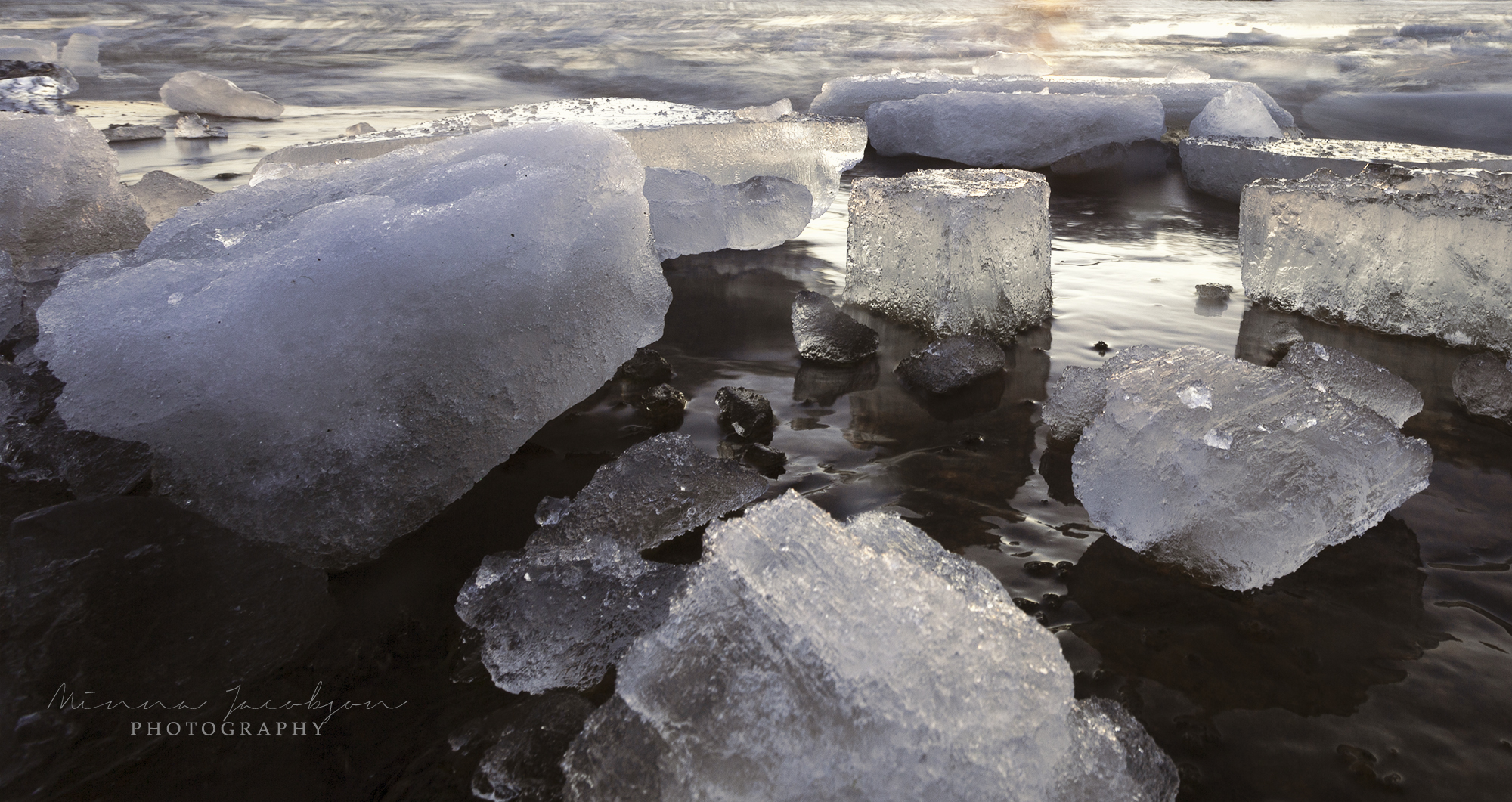
Light plays a crucial role in photography, shaping the atmosphere and mood of an image. The amount, color, and direction of light significantly impact the final result. Soft morning and evening light often create a warm and natural look. Harsh midday sunlight can result in strong shadows and high contrast. You can read more about photographing in morning light here. I have also written about the backlight in my last post.
Night Photography
The amount of light changes throughout the day. At night, celestial bodies and phenomena like the aurora borealis influence the available light. Typically, though, light is scarce. Night photography differs greatly from daytime photography, requiring high ISO values, a wide aperture, and slow shutter speeds. A tripod is essential for night shots. The lens should be set to manual focus with the focal distance adjusted to infinity.
Setting the Lens for Night Photography
When focusing manually for night photography, autofocus often struggles due to low light conditions. The best approach is to switch the lens to manual focus. Use live view mode to zoom in on a bright star or distant light. Once the focus is sharp, it should stay unchanged unless the focal length is altered.
ISO and Noise Considerations
High ISO settings are necessary for night photography but introduce noise. The level of noise depends on the camera sensor and its resolution. Larger sensors with lower pixel density generally handle noise better. Modern full-frame cameras, for example, function well at high ISOs, while crop sensors may produce more noticeable noise.
Chasing the Milky Way in Kopparnäs, Finland
For a long time, I have dreamed of capturing the Milky Way. Yet, winters in Finland have become increasingly cloudy. Additionally, light pollution in the Helsinki metropolitan area makes it difficult to see the Milky Way.
Cloud Radar and Weather Forecasts
To get a clear view, I need to travel approximately 50 kilometers away from the city to Kopparnäs. Monitoring cloud radar and weather forecasts helps determine the best opportunities. Nonetheless, I’ve noticed that forecasts change often. They are not always reliable.
On My Way to Kopparnäs
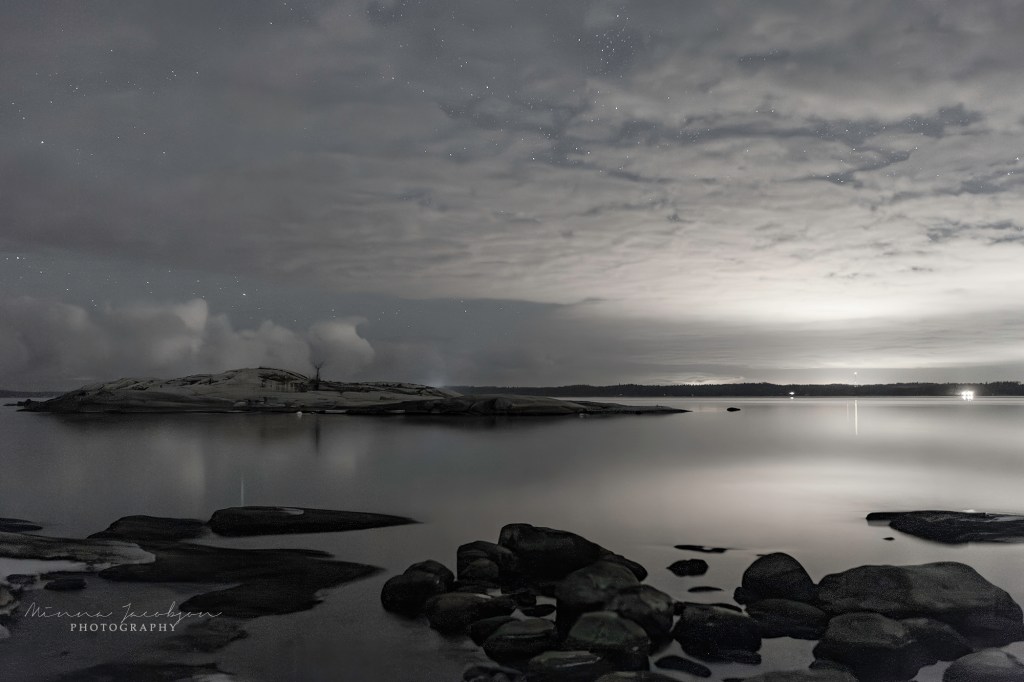
In December 2023, I attempted to photograph the Milky Way by the sea. The best time to view it in Finland is typically from late summer to early winter when the nights are darkest. The cloud radar predicted a clear sky in Kopparnäs. During the drive, the sky looked promising.
Upon arrival, I wandered in the dark, searching for the right location. It’s remarkable how much one’s sense of direction diminishes in the dark. I ended up in a different spot than I had initially planned. However, I found a suitable location in the end.
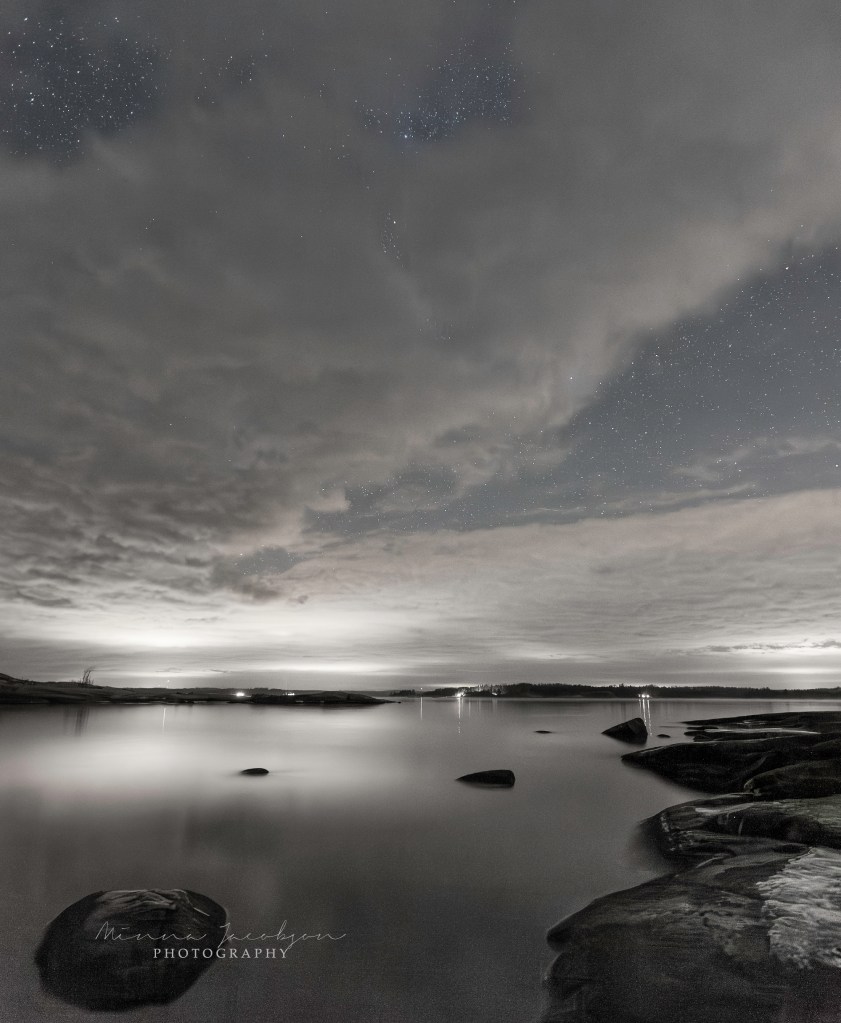
Camera settings for my Milky Way shots:
- First image: ISO 4000, focal length 35mm, aperture f/2.8, shutter speed 10s.
- Second image: ISO 2500, focal length 16mm, aperture f/2.8, shutter speed 10s.
As seen in my photos, the Milky Way is partially visible through the clouds. Unfortunately, I couldn’t capture it in its entirety.
Headlamp is Essential for Night Photography
For night photography, I use a headlamp with a red light. Red light helps eyes adjust to the darkness and doesn’t disturb other photographers. It also assists in setting up the camera.
Processing the images
I processed the images in Lightroom, where I adjusted the exposure and reduced noise. In Photoshop, I fine-tuned the images further. For these night shots, I used a black-and-white Gradient Map adjustment layer, modifying its visibility to achieve the desired effect.
Snowfall Photography in Kopparnäs, Finland
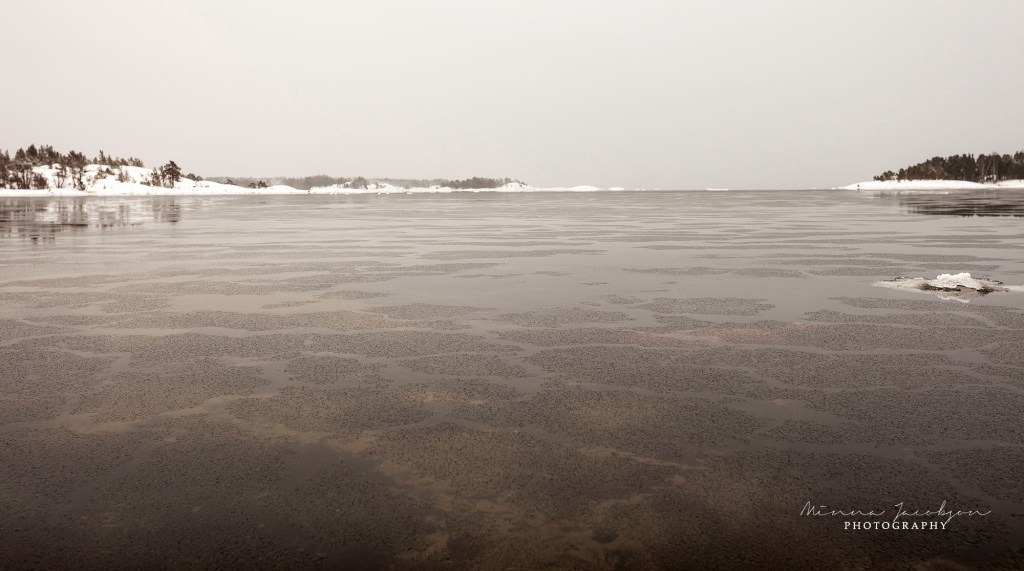
I don’t usually photograph during the day. However, in December 2023, snowfall in Kopparnäs inspired me and I decided to capture the wintry scenery.
The images have different moods due to the snowfall and the time of day they were taken.
- The first image was captured early in the morning.
- The other two were taken later in the day when the sun was higher.
By the way in Finland, December days are only about four hours long. This means that there is only couple of hours so much light, that the ISO can be kept in 100.
Freeze the Motion of Snowflakes
Snowfall photography requires a fast shutter speed, usually between 1/250s and 1/500s, to freeze the motion of snowflakes. Additionally, the snowflakes need to be large to be visible in the images.
In my case, the shutter speed was too slow, so individual flakes didn’t appear clearly in the pictures.
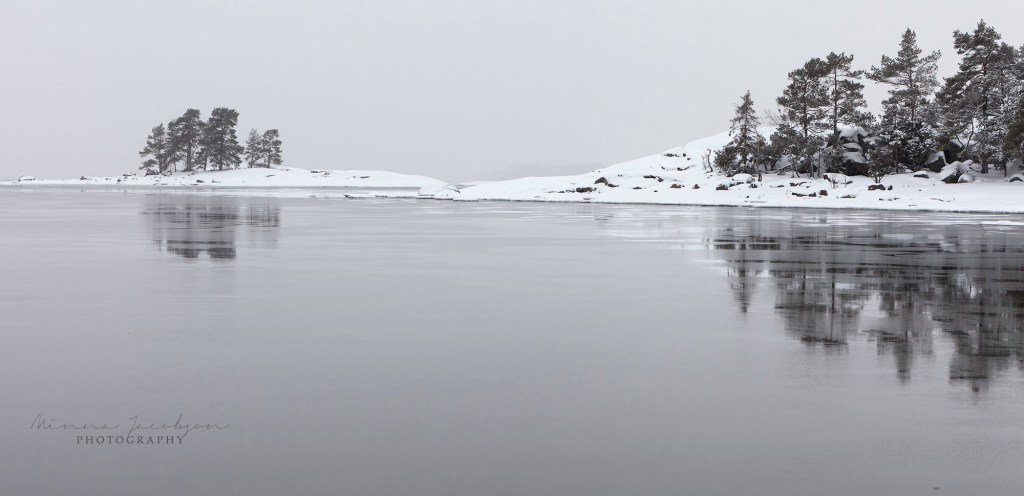
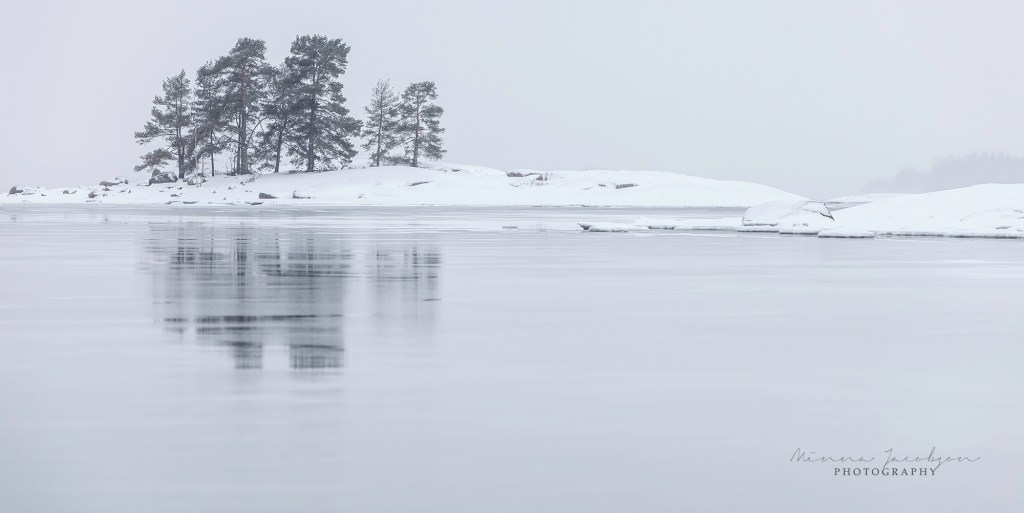
Camera settings:
- First image (no snowfall): ISO 100, focal length 35mm, aperture f/7.1, shutter speed 1/30s.
- Snowfall images: ISO 100, focal length 160mm, aperture f/5.6, shutter speed 1/30s.
Capturing Waves and Ice in December
Throughout December, the weather remained overcast. However, during Christmas week, a storm that had ravaged Western and Central Europe reached Finland, clearing the skies. The temperature was mild, and strong southern winds broke the ice formations in Kopparnäs into small ice blocks. I enjoyed spending time by the shore.
One of my goals for this photography trip was to capture water splashes.
Capturing the Power of the Sea – The Splash Shot
This image was taken on a windy December day at Kopparnäs, Finland. A powerful southern wind had broken the ice into small chunks, which the waves then tossed onto the shore. The setting sun illuminated the water spray, creating a dramatic and almost otherworldly effect.

Settings
To capture this moment, I used a shutter speed of 1/15s. This allowed me to freeze the motion of the splash. It preserved a slight softness in the movement of the ice and water. The settings were:
ISO 100, focal length 27mm, aperture f/9, shutter speed 1/15s.
Challenges
The biggest challenge in photographing this scene was the unpredictable nature of the waves. Timing was everything—too early, and there was no splash; too late, and the energy was lost. Additionally, the sea spray constantly hit the camera lens, making it tricky to keep it clean.
Processing the Image
I processed the image in Photoshop, where I fine-tuned the highlights and shadows to bring out the contrast between the golden sunlight and the icy foreground. The light’s interaction with the water and ice makes this image special to me. It perfectly demonstrates how light transforms a scene.
This shoot was a reminder that sometimes the most captivating images come from embracing nature’s wild, unpredictable side.
Waves and Ice
These two images illustrate how the wind tossed ice blocks onto the shore. It was amazing moment by the sea. I was so happy of the sunny afternoon we got even it was expected to be cloudy day.

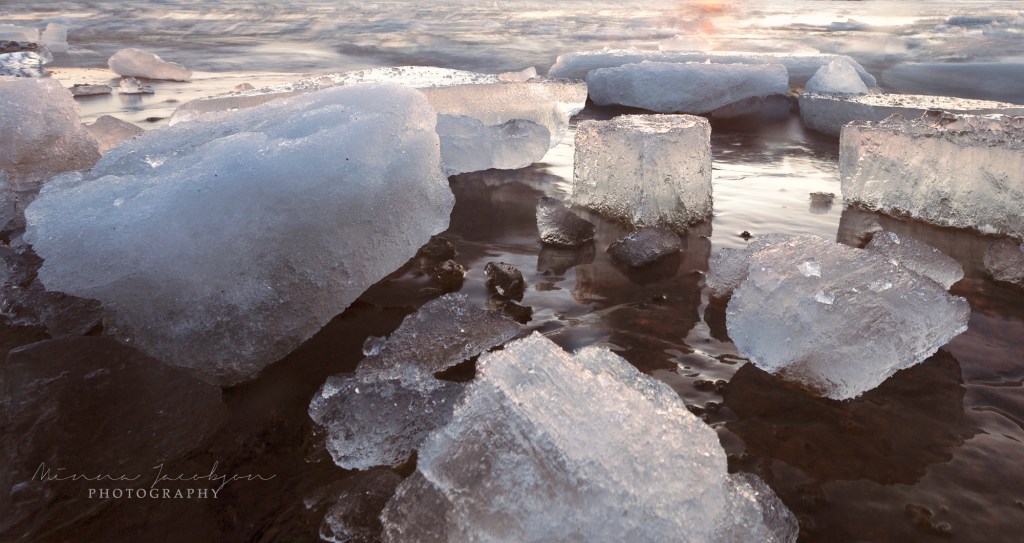
Settings for wave and ice photography:
- Second image: ISO 100, focal length 16mm, aperture f/16, shutter speed 1.6s.
- Third image: ISO 100, focal length 16mm, aperture f/11, shutter speed 0.5s.
Photography, whether at night or in daylight, always presents unique challenges. The unpredictability of weather, light conditions, and natural elements keeps the process exciting. Although each trip might not achieve a perfectly clear Milky Way or sharply frozen snowflakes, it provides valuable experience. It also offers inspiration for the next adventure.
My Gear
I photograph with a Canon 5D Mark IV. For these photos, I used the EF 70-200mm f/2.8L IS USM and EF16-35mm f/2.8L II USM. I typically use a tripod, as it significantly improves image sharpness.
Thank YOU!
Thank you for visiting my blog and exploring this post! I hope you found it helpful.
Would you like to share your experience either of the topics in my post? Have you gotten stunning Milky Way shots? How about snowfall, what hints do you have to share? And last but not least, the splash, how you have succeeded to get great splash shot?
I would love to hear your thoughts! Your feedback means a lot to me and helps me and my readers grow as a photographer.
Feel free to follow my blog for more stories and photography projects—there’s a link at the bottom of the page. Bye-bye!
 MINNA JACOBSON
Finner dina vintergata bland molnen mycket intressant, nytt tänk och ett spännande ljus över vattnet. Vattenstänk i min värld är väldigt många bilder, mycket kort slutartid eller att prova sig fram mellan 1/2 till 1/30 sekund. Som regel 95% misslyckade, men vad gör det.
LikeLiked by 1 person
Vattenstänk är inte lätt att fotografera. Om jag kommer ihåg rätt, tog jag kanske 50 bilder och en var okej 🙂 Men vi bör komma ihåg att ju mer du gör, desto bättre blir du (eller något sådant… 🙂 )
LikeLiked by 1 person
Your photographs are so impressive. I love ice and water images. That splash photo is stunning. But I love the nighttime photos as well. You have clearly made the most of the classes you too.
LikeLike
Thank you so much Carol! I am glad you liked my photos. For me water and ice, as for you, are important elements. I could sit by the water element for ages and just listen the sound of it. Have a great day!
LikeLike
Thank you very much for this hugely informative post.
LikeLike
You are welcome Lynette. I am glad you found my post valuable.
LikeLiked by 1 person
The Milky Way stars look like diamonds. Amazing! The water photos are wonderful! I can hear the waves.
LikeLiked by 1 person
I agree with you, they look like diamonds 😁 Thank you so much for your comment Magickmermaid😍🌟
LikeLiked by 1 person
Gorgeous
LikeLiked by 1 person
Thank you Sherry 🙂
LikeLike
Let’s not forget to slowly acclimate the gear to the sudden change in temperature from indoors to outdoors, and back inside! 😊
LikeLiked by 1 person
Yes, important reminder!!
LikeLiked by 1 person
Wonderful winter images and a wealth of information … great post Minna!
LikeLiked by 1 person
Thank you Denise 💫🌟🤩
LikeLiked by 1 person