
The Northern Lights arrive unannounced, dancing across the sky in a breathtaking show. Each appearance sparks excitement on social media, as people rush to capture the celestial show. Before I took my first aurora photo, I often wondered if I would ever witness this phenomenon in person.
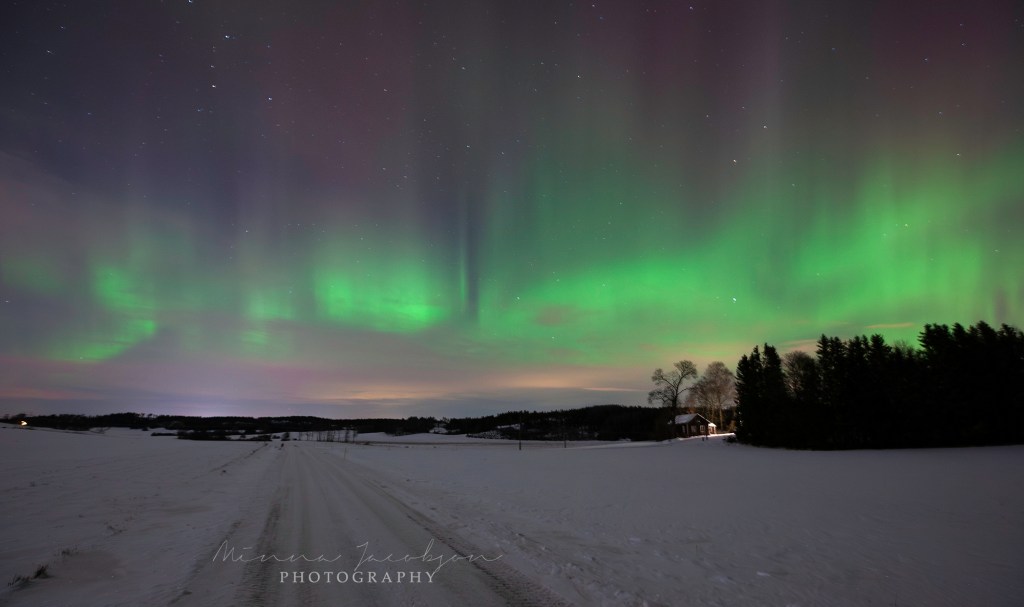
Photographing the Northern Lights is both thrilling and challenging. They reveal themselves only in darkness, often requiring long nights outdoors. The excitement keeps me awake, but by morning, exhaustion sets in. Still, every sleepless hour is worth it for the beauty of the auroras.

The settings in these two images are not optimal, as I used an aperture of f/5.6 and a 15-second shutter speed for the relatively fast-moving auroras. As mentioned at the end of this post, the aperture for aurora shots should be as wide as possible (f/2.8 or f/4). If I had used f/2.8 (a two-stop change), the shutter speed would have dropped to 3.75 seconds. This would have been better, as the auroras were moving quite quickly. With such a long shutter speed, the auroras are not sharp enough.
The Science Behind the Magic
The Northern Lights are created when charged particles from the sun collide with Earth’s atmosphere, exciting gas molecules and causing them to glow in different colors:
- Green – The most common, created by oxygen at lower altitudes.
- Red – A rarer sight, formed by oxygen at higher altitudes.
- Blue & Violet – Caused by nitrogen, often appearing alongside other colors.
Chasing the Lights
In this post, I’m sharing images from four different photo sessions. I will also explain the settings I have been using and how I would change them.
Most of my Northern Lights photography has been shot in winter. But one unforgettable exception occurred in August 2024: a powerful geomagnetic storm lit up the sky across much of Finland. The best views were in the south, where the night was dark enough for the auroras to shine brightly.
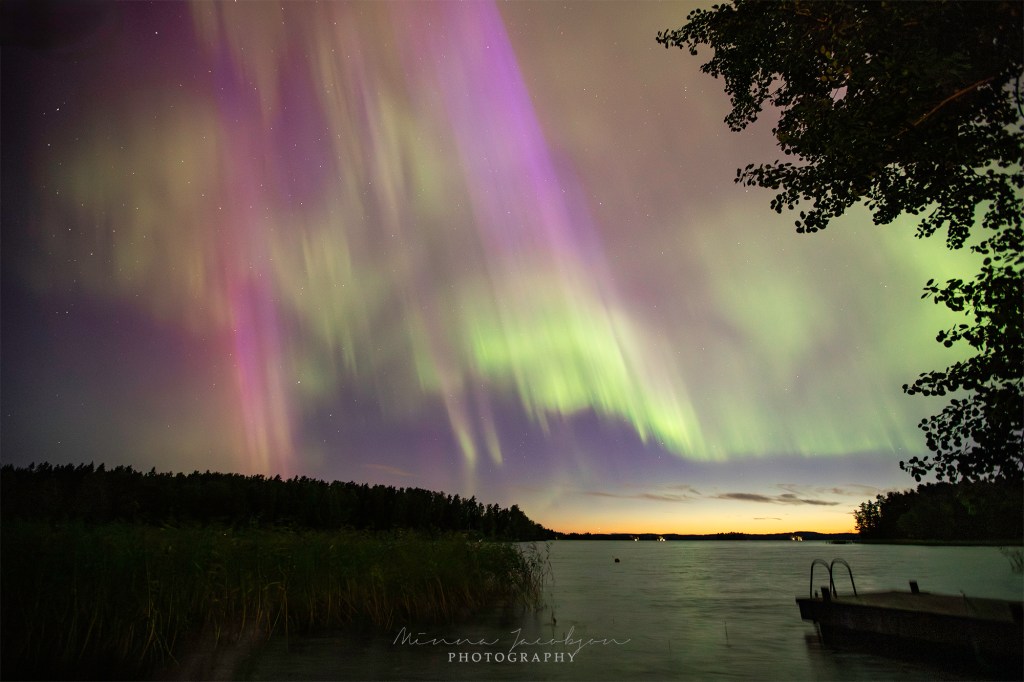
On a warm August evening, I stood watching fast-moving, cloud-like shapes in the sky. The Northern Lights looked like faint wisps, nearly blending with the clouds. But their movement gave them away. While invisible to the naked eye, my camera revealed a spectacular show with colors beyond just green.
One thing I’ve learned is to always look straight up. You might just spot the Northern Lights corona. It’s a rare and mesmerizing sight where the lights swirl directly overhead.

With such a high ISO (4000), there is a risk of noise in the image. The reason for using such a high ISO, was the 1,6 shutter speed. To reduce noise, I could lower the ISO to 2000 (one stop). However, to maintain the same exposure, I would need to compensate by increasing the shutter speed to 3.2 seconds. Afterwords it is easy to realize 3,2 s would have been enough. Next time I will keep that in my mind!
A Night to Remember – Moonlight & Auroras
The end of November 2024 offered a rare and magical combination—a full moon and the Northern Lights glowing together. The landscape looked almost unreal, bathed in silvery moonlight, while vibrant green, red, and violet auroras danced above. It was also a night when the lake started for freeze. The sound of the freezing lake is something to remember.
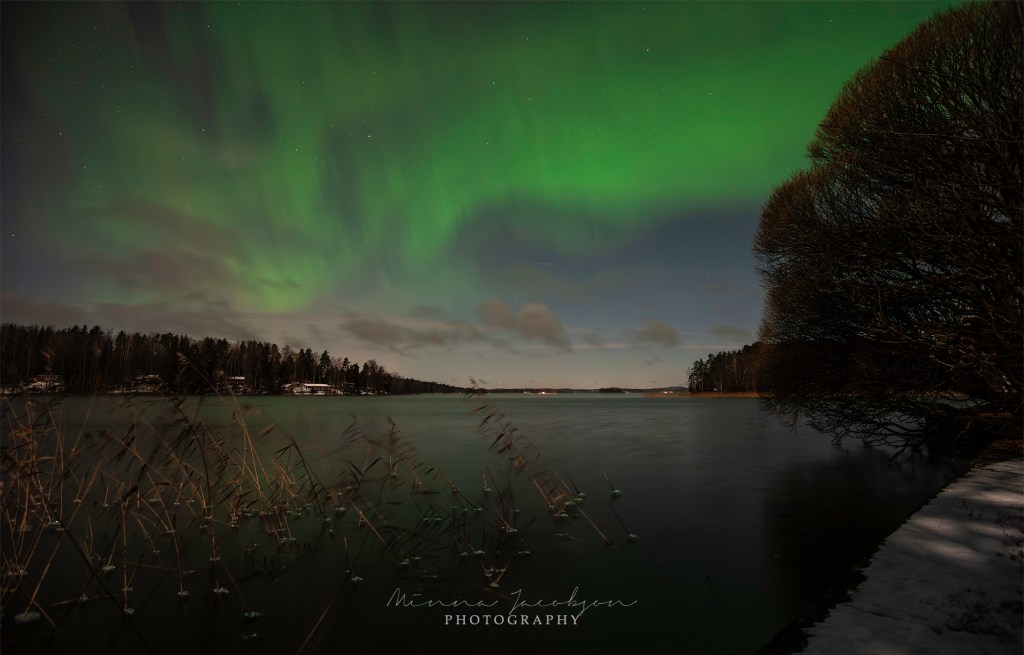
With temperatures at -10°C, staying outside for hours required proper clothing. From experience, down-filled trousers, boots lined with sheepskin, and warm gloves are essential. With the right gear, even the coldest nights become enjoyable.

I decided to use a 10-second shutter speed for this shot as the auroras were moving slowly. But maybe I should have used a higher ISO (e.g., 1600) since the auroras were faint. Then I could have decrease the shutter speed to 5 seconds which might have been enough.
Cloudy Skies & Fleeting Moments
Winters in Southern Finland are often cloudy, reducing the chances of seeing auroras. At the beginning of this year 2025, the auroras were active across the country. However, thick clouds covered the sky in the South. Then, for a brief moment, the clouds parted. The auroras were intense and shining through the clouds.
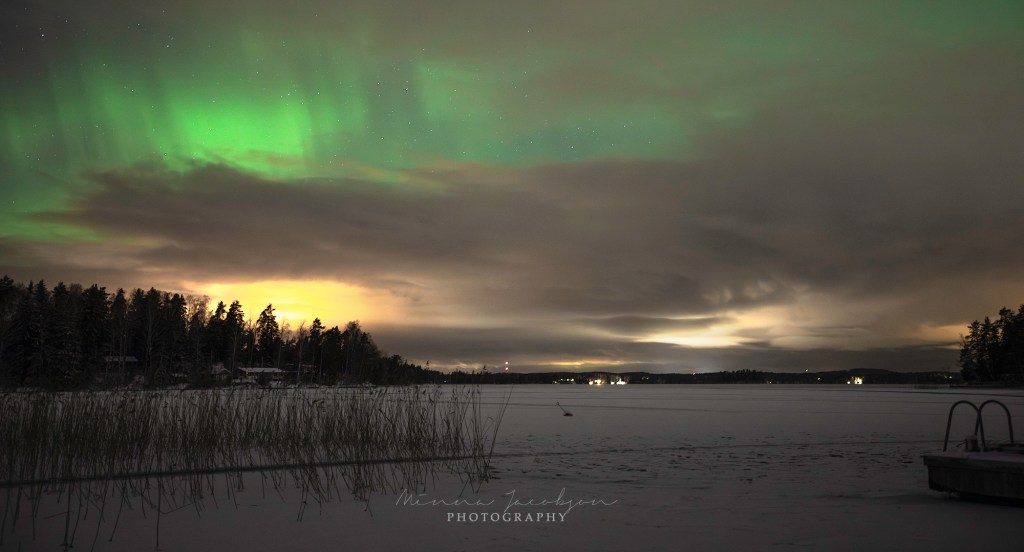
These photos are among my favorites—they have a mysterious, dreamlike quality, different from the typical aurora shots.

These setting are optimal, I would not change anything!
How to Photograph the Northern Lights
Capturing auroras requires preparation, patience, and the right camera settings. Here are my key tips:
- Use a Tripod – A sturdy tripod prevents motion blur during long exposures.
- Camera Settings:
- Manual Mode (M) – Full control over exposure.
- Aperture – Use the widest possible (e.g., f/2.8 or f/4) to let in more light.
- Shutter Speed – Start with 5–15 seconds. Faster-moving auroras need shorter exposures (2–5s), while slower ones allow for longer (10–20s).
- ISO – Begin with ISO 1600–3200. Adjust based on brightness—higher for faint auroras, lower for bright ones.
- Manual Focus – Autofocus struggles in darkness. Set your lens to infinity (∞) and fine-tune by zooming in on a bright star or some light source.
- Remote Shutter or Timer – Prevents camera shake when pressing the shutter. A 2-second timer also works.
- Frame the Shot – Foreground elements like trees, mountains or lakes add depth and interest.
- Check Weather & Aurora Forecasts – Clear skies are essential. Use apps like NOAA or SpaceWeatherLive to track geomagnetic activity. I use Ilmatieteenlaitos. This gives me insight for aurora activity in the southern part of the Finland.
- Dress Warmly & Be Patient – The best displays can take hours to appear. Insulated clothing, down trousers, and warm boots are a must for staying comfortable.
Where & When to See the Northern Lights
The Northern Lights are strongest near the poles, where Earth’s magnetic field directs charged particles. Northern Finland, closer to the Northern Lights zone, experiences more frequent and intense displays.
Artificial light pollution in the south reduces visibility. I usually head to my cottage, where the sky is darker. The further south you are, the lower the auroras appear on the horizon. In Southern Finland, the auroras might only show as faint green streaks. In the north, they stretch overhead in vibrant waves.
During strong geomagnetic storms, the Norther Lights zone shifts south. This shift allows bright Northern Lights to even in Southern Finland. However, this requires exceptional solar activity.
Sometimes, in the south, auroras appear only as faint grayish clouds to the naked eye. But with a long-exposure camera, they are revealed in vivid colors. In the north, they are often very strong. They glow brightly in green, red, or violet. This glow is visible even without a camera.
My Gear
I photograph with a Canon 5D Mark IV. For these photos, I used EF16-35mm f/2.8L II USM lens. And tripod!
Thank YOU!
Thank you for visiting my blog and exploring this post! I hope you found it helpful.
Have you gotten stunning aurora shots or even seen the Northern Lights? What is favorite place to spot the Northern Lights? Please share your thoughts about the auroras or night photography in general!
Feel free to follow my blog for more stories and photography projects—there’s a link at the bottom of the page.
 MINNA JACOBSON
Oh my, these are wonderful. The photos are all great but that last one is stunning. If there was one experience I could have maybe it would be to see the lights like this. I’d much rather see this that any made-made presentation, hands down. I would regard it as a privilege. Thank you so much for sharing your pictures of something so special.
LikeLiked by 1 person
Thank you so much for your comment 😁🤩 The Northern Lights are so impressive and especially when they are colorful 🌟🌟
LikeLike
Absolutely gorgeous! Every photo is amazing; especially the one with the large section of violet light and twinkling stars.
LikeLiked by 1 person
Thank you Magickmermaid 😁🤩
LikeLiked by 1 person
All of your photos are beautiful Minna, it’s hard to pick a favourite. I have seen the Southern Lights only twice, here in Tasmania last year, but I think the Northern Lights are more visually stunning and can be seen without a camera. One of my dreams is to see the aurora in the northern hemisphere with my own eyes, but in the meantime, I will try your photography tips with my camera and hope to get some photos as good as yours! 🙂
LikeLiked by 1 person
Thank you Sue! I wish you luck with the aurora photography 👍🤩
LikeLiked by 1 person
Thanks for this very informative post about photographing the Aurora. I used to live in the subarctic and took photos of it there but could have done with your good knowledge. Cheers.
LikeLiked by 1 person
Thank you Lynette!
LikeLiked by 1 person
Otherworldly spectrums of color! I hope to see this phenomenon in my life. I don’t think I’ll capture the moment as well as you did, but I can enjoy your photos until then! 😊
LikeLiked by 1 person
Thank you for your kind comment! If you travel to the Northern during winter, you may experience the Northern Lights 😁 My dream is to see them in Lappland where they are more intense!
LikeLiked by 1 person
This is a great collection! The last image is really special. And thank you for the tips!
LikeLiked by 1 person
Thank you so much for your kind comment! I am glad if you find my tips usefull 😁
LikeLiked by 1 person
These images are stunning Mina! Great tips too! 🙂
LikeLiked by 1 person
Thank you Denise 😁🤩
LikeLiked by 1 person